How to Set Up a Cozy Reading Nook: Choosing Your Spot Before Furniture

A reading nook doesn’t need a dedicated room, a big budget, or a house full of built-in shelving. What it needs is intention — a small corner of your home carved out specifically for sitting, reading, and ignoring the rest of your to-do list. Done well, even a narrow alcove or an underused window bay becomes a place you actively want to retreat to.
This guide walks through everything from choosing the right spot to the small finishing touches that tip a seat-and-a-lamp into something that genuinely feels like your own.
1. Pick the Right Spot Before You Buy Anything
Location shapes every other decision you’ll make, so get this right first.
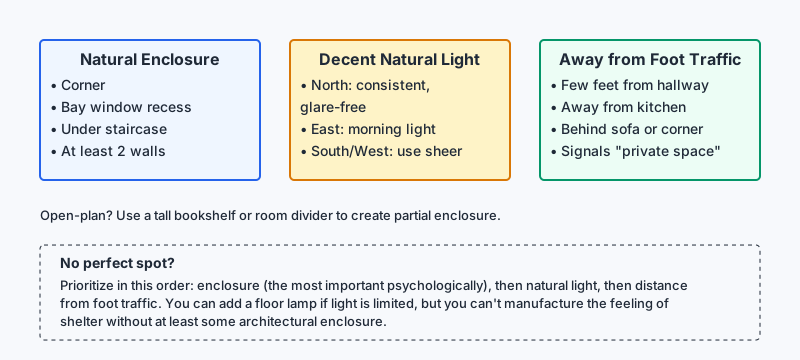
Look for a place that meets three basic criteria:
- Some natural enclosure. A corner, a bay window recess, a closet you’ve emptied, the space under a staircase — anywhere that provides at least two walls or a ceiling drop gives an instant sense of shelter. Psychologists refer to this as “prospect and refuge” — the preference humans have for positions that offer a wide view with a protected back. You don’t need the jargon; you just know the feeling when you’re in a spot like that.
- Decent natural light. A north-facing window delivers consistent, glare-free daylight in the Northern Hemisphere — ideal for reading without squinting. East-facing works well for morning readers. South and west windows are bright but benefit from a light sheer curtain to diffuse harsh afternoon sun.
- Distance from foot traffic. Even a few feet of separation from a hallway or the kitchen reduces interruptions. A spot behind a sofa or tucked around a corner psychologically signals “private space” to the rest of your household.
If you’re working with an open-plan apartment, a tall bookshelf or a simple room divider screen can create a partial boundary where none exists architecturally.

If your reading nook has to share space with a small room, How to Make a Small Room Look Bigger: Light, Color, And Tone Tricks has useful tricks for making the area feel more open.
2. Get the Seating Right
This is the element people get wrong most often — either by choosing something that looks great but is uncomfortable after twenty minutes, or by repurposing a chair that was never designed for sustained sitting.
What actually works for long reading sessions
- A chair with lumbar support and a slightly reclined back. Fully upright dining chairs create back fatigue. Fully horizontal (a sofa or chaise) tends to lead to falling asleep faster than finishing a chapter. The sweet spot is a chair angled between 100–110 degrees — a slight recline that keeps the spine supported.
- Armrests at the right height. Your forearms should rest naturally, not forced up by high armrests or dangling with low ones. When you’re holding a book, relaxed shoulders matter.
- Enough depth in the seat. A seat depth of 18–22 inches accommodates most adults. Anything shallower and you’ll perch; anything deeper and your lower back loses contact with the support.
A classic armchair, a bergère, a wing-back, or even a well-chosen chaise lounge all work. So does a window bench with a thick cushion (4 inches or more of foam) and back cushions propped against the wall. The bench is often the most space-efficient option in a small nook.
If you’re adding a footstool or ottoman, make sure it’s roughly the same height as the seat — so your legs rest flat rather than angling down or upward.
3. Layer the Lighting
Overhead ceiling lights are almost always wrong for reading nooks. They create glare on the page and flatten the intimate atmosphere you’re trying to build.
Instead, work with two or three light sources at different heights:
- A task light aimed directly at the reading surface. A swing-arm wall lamp is the cleanest solution in a small space — it doesn’t take up floor or surface space, and you can angle it precisely. Look for one rated at 450–800 lumens for reading, with a warm white color temperature (2700K–3000K). Cooler, bluer light (above 4000K) increases alertness but is harder on the eyes for extended reading.
- An ambient fill light. A small table lamp or a plug-in LED strip tucked behind a bookshelf reduces the contrast between the bright reading surface and a dark surrounding wall — that contrast is what causes eye strain, not the brightness itself.
- Optional: a dimmable overhead or pendant. If the nook is in a recessed space, a small pendant light above it can mark the zone architecturally while letting you dial down brightness when you switch to ambient reading rather than close text.
Dimmer switches or smart bulbs with adjustable brightness are worth the small additional cost. The ability to shift from 600 lumens for a novel to 200 lumens for late-night picture books makes the space genuinely flexible.

4. Control the Surrounding Noise
Acoustics matter more than most decorating articles admit. A reading nook next to a noisy kitchen or under a room where children run around stops being restful quickly.
A few practical fixes:
- Soft surfaces absorb sound. A thick rug under and around the chair, heavy curtains, upholstered furniture, and even the books themselves on open shelves all reduce sound reflection. Hard floors in open-plan spaces are acoustically unforgiving.
- Earbuds or over-ear headphones playing low-level ambient audio (rain, brown noise, café sounds) can mask household noise without requiring you to renovate anything. Many readers swear by binaural focus playlists; others prefer total silence. Know which you are.
- A white-noise machine placed nearby costs less than redecorating and genuinely dulls the random spikes of household sound that break concentration.
If you’re building a nook inside a closet conversion, basic acoustic foam panels on the back wall can make a surprisingly large difference.
5. Temperature, Textiles, and the Sensory Layer
A reading nook should feel slightly warmer and more enclosed than the rest of a room — that’s part of what makes it feel like a retreat rather than just a chair.
If you enjoy tweaking the sensory feel of a space, How to Make Your Bedroom More Relaxing: 12 Practical Changes offers plenty more ideas for making a room calmer and cozier overall.
Textiles
- A throw blanket draped over the arm of the chair is both functional and visually inviting. Wool, cotton-knit, or bamboo blends all breathe better than synthetic fleece for extended sitting.
- A cushion at lower back height is more useful than a decorative arrangement of throw pillows that you have to move before sitting down. One or two, positioned where your body actually needs them.
- A small rug defines the nook’s footprint even in a larger room. A round or oval rug works well under a standalone armchair; a rectangular runner suits a window bench.
Temperature
If your reading spot is near an exterior wall or drafty window, a small ceramic panel heater or a plug-in baseboard heater placed at ankle height can make cold months far more comfortable. Reading in a cold nook is a fast path to abandoning the habit entirely.
Conversely, if your home runs warm, a small USB desk fan or a ceiling fan overhead (on its lowest setting) keeps air circulating without noise.
6. Shelving: Keep Books Within Arm’s Reach
One of the practical failures of many reading nooks is that books live across the room. You finish one, want to start another, and now you’re up and moving — the spell is broken.
The solution is simple: get at least some storage adjacent to the seating.
- A small beside-the-chair side table with a lower shelf or a magazine rack underneath handles a rotating current-reads stack well.
- A floating shelf at eye level when seated lets you scan titles without getting up.
- Built-in shelving around a window seat is the aspirational version — effective, beautiful, and not as expensive as it looks if you use stock IKEA BILLY units flanking the window rather than custom carpentry.
- A small ladder shelf beside a floor chair takes no wall mounting and holds 20–30 books easily.
Keep the adjacent storage stocked with books you actually intend to read soon, not books you’re archiving. The sense of surrounded-by-books intimacy comes from proximity and variety, not quantity.

7. Manage Distractions Deliberately
Design your nook to make distraction slightly harder, not impossible. That distinction matters — trying to make it impossible creates anxiety; making it marginally harder creates a helpful nudge.
- Leave your phone outside the nook. Not powered off, not face-down — in another room or on a surface you can’t reach from the chair. Even the presence of a phone reduces reading focus, as multiple attention researchers have documented.
- A physical “do not disturb” signal — something as simple as a particular lamp being on, or a door position — signals to housemates that you’re in a reading block. Agreeing on this signal in advance is far more effective than asking people to simply notice you reading.
- A specific time container works better than “I’ll read until I feel like stopping.” A 30–45 minute block with a timer (phone timer left outside the nook, kitchen timer nearby) feels less open-ended and is easier to protect.
8. Personalize It So You Actually Use It
This sounds obvious but most reading nooks fail because they’re decorated for a Pinterest aesthetic rather than for the actual person using them.
Ask yourself a few direct questions:
- Do you read with a hot drink? Then a small side table at a reachable height, plus a coaster, is non-negotiable — not optional décor.
- Do you have a dog or cat that will join you? Build in space for that, or the animal will displace you.
- Do you read physical books, an e-reader, or both? If an e-reader, you need a charging cable run somewhere tidy; if physical books, you need more light on the page.
- Do you read for an hour or three? Longer sessions warrant a proper footrest and a chair with more lumbar support than a shorter session demands.
Personalization also means visual comfort — a small plant, a framed print, a candle. These aren’t frivolous. They make the space feel claimed and maintained, which makes you return to it.
If you’re setting up quiet spaces for the whole family, How to Set Up a Homework Station for Children offers similar principles applied to a child’s workspace.
9. Keep It Maintained
The fastest way to stop using a reading nook is to let it become a dumping ground for laundry, bags, and random objects. Treat it like a small, semi-formal space that has a single purpose.
A five-minute reset at the end of each week — books back on the shelf, throw folded, surfaces cleared — keeps the nook functional and inviting. A space that looks a little neglected subtly signals “not ready” every time you walk past it, which nudges you toward the sofa instead.
Putting It Together
Building a reading nook is less about acquiring the right furniture and more about making a deliberate claim on a small piece of your home. The spot you choose, the light you put there, the comfort of the seating, and the small details that make the space feel like yours — all of these compound.
Start with just the spot and the seating. Add good task lighting within a week or two. Layer in textiles, storage, and finishing touches as you understand how you actually use the space. Most readers find that a nook they’ve built gradually — adjusted to real use rather than assembled in a single weekend shop — gets used far more than one that was perfect on the first day and never quite fit their habits.