How to Make Your Bedroom More Relaxing: 12 Practical Changes

Most people spend roughly a third of their lives in the bedroom, yet it’s often the last room to get any real attention. We hang whatever art was leftover from the living room, pile unread books on the nightstand, and wonder why sleep feels so elusive. The bedroom shapes your nervous system’s willingness to wind down — and the good news is you don’t need a renovation to improve it.
Below are twelve specific, actionable changes, organized from the highest-impact to the kind of fine-tuning you do once everything else is already humming.
1. Start With Temperature — Not Décor
Before you buy a single throw pillow, fix the temperature. Core body temperature needs to drop by about 1–2°F for sleep onset to happen, and the bedroom environment directly influences that process. The National Sleep Foundation cites 60–67°F (15–19°C) as the ideal range for most adults.
Practical fixes:
- Ceiling fan on low — moves air without dropping humidity.
- Separate duvet inserts for couples who run at different temperatures (sometimes called the “Scandinavian sleep method”).
- Breathable bedding — natural linen or percale cotton dissipates heat better than polyester microfiber.
If your HVAC system can’t hold a steady temperature, a programmable smart plug paired with a standalone fan or small space heater gives you surprisingly fine control.

2. Control Light at Every Hour
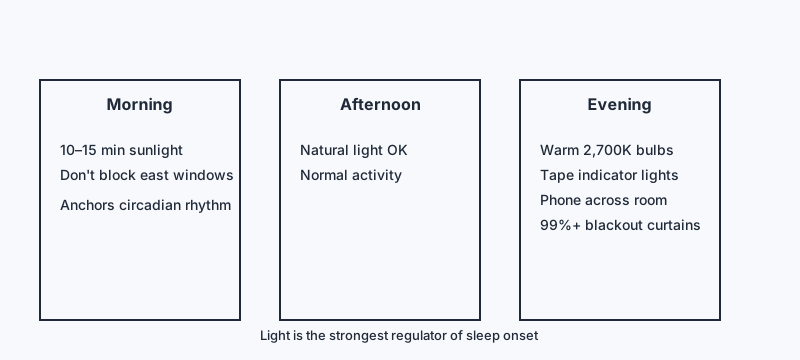
Light is the single most powerful external regulator of your circadian rhythm. Bright, blue-spectrum light suppresses melatonin — so a glowing phone screen or a streetlamp leaking through thin curtains directly delays sleep.
Daytime light
Actually invite it in. Morning sunlight exposure — even just 10–15 minutes — anchors your internal clock and makes falling asleep easier later. Don’t block east-facing windows during daylight hours.
Evening and nighttime light
- Blackout curtains are worth the investment. Look for fabric rated 99%+ light blockage rather than marketing terms like “room darkening.”
- Warm-spectrum bulbs (2,700K or lower) in bedside lamps help signal the shift to night mode.
- Cover indicator lights on electronics with a strip of electrical tape. A small red standby light might seem trivial, but in a dark room, it matters.
The phone problem
Keeping your phone across the room — rather than on the nightstand — sounds like cliché advice, but it removes both the blue light and the psychological pull to check one more thing. A cheap alarm clock means you have no excuse to bring the phone to bed.
3. Reduce Noise (or Replace It With Better Noise)
Silence isn’t always achievable, and for some people it’s not even desirable. The goal is consistent sound without sudden spikes.
- White noise machines mask traffic, neighbors, and partner movement. Look for mechanical fans or dedicated sound machines — phone apps introduce screen time and notification risks.
- Acoustic curtains and a door draft stopper cut more decibels than most people expect without any construction.
- Rugs and soft furnishings absorb reflected sound and reduce the sharp echo that hard floors create at night.
If you live in a genuinely noisy environment (near a highway or airport), a combination of acoustic curtains + white noise is more effective than either alone.
4. Invest in Your Mattress and Pillow — Actually Invest
A mattress that’s more than seven to ten years old, or one that leaves you waking with stiffness, is undermining everything else on this list. You can optimize lighting and temperature perfectly and still sleep badly on a collapsed mattress.
What to look for:
- Firmness is personal — there’s no universally “correct” firmness. Side sleepers generally benefit from softer surfaces that cushion the shoulder and hip; back and stomach sleepers tend to do better on medium-firm.
- Pillow loft matters — a pillow that’s too thick or too flat throws your spine out of alignment regardless of the mattress quality.
- Trial periods — most reputable mattress companies offer 90- to 365-night trials. Use the full trial if you’re unsure; bodies take weeks to adapt.

5. Declutter With Intention
Visual clutter raises cortisol. Multiple studies on environmental psychology link disorganized spaces to elevated stress and difficulty concentrating — both counterproductive to relaxation. But the goal isn’t Instagram minimalism. It’s removing anything that signals unfinished work to your brain.
The bedroom is particularly sensitive to work creep: a laptop on the desk, a pile of mail on the dresser, gym clothes draped over the chair. Each item is a low-level mental to-do item.
A practical rule: everything in your bedroom should either help you sleep, help you wake up comfortably, or genuinely please you aesthetically. If it doesn’t do one of those three things, it’s noise.
Storage solutions that actually help:
- Under-bed storage bins for seasonal items (keeps floors clear).
- A single nightstand drawer dedicated to bedtime items only (book, lip balm, earplugs).
- A closed wardrobe or even a curtain over an open clothes rack keeps visual disorder out of your sightline from bed.
6. Choose Colors That Work For You
Color psychology in bedrooms is real, though often overstated. You don’t need to repaint everything sage green to sleep well. But it’s worth knowing the basics:
- Cool, muted tones (soft blue, pale gray, warm white, sage) tend to feel calmer than saturated primaries.
- Your existing emotional associations matter more than any universal rule — if you find warm terracotta deeply comforting, that’s legitimate data.
- Contrast matters as much as hue. A room with very high light-dark contrast (dark walls, white trim, bright bedding) reads as more visually stimulating.
If repainting isn’t on the table, a new duvet cover or a couple of cushions can shift the dominant color tone of the room at low cost.
If you’re rethinking your palette for a calmer mood, How to Make a Small Room Look Bigger: Light, Color, And Tone Tricks offers related tricks for using light and color to reshape how a space feels.
7. Introduce a Scent Anchor
Olfactory memory is unusually direct — scent bypasses the thalamus and connects almost immediately to the limbic system (the brain’s emotional center). You can use this deliberately.
Choose a single, consistent scent for your bedroom and use it only there. Lavender is the most studied option — there’s reasonable clinical evidence that lavender aromatherapy reduces anxiety and improves sleep quality for many people, though the effect size is modest. Other options people find calming: cedarwood, sandalwood, or bergamot.
Delivery methods:
- Reed diffusers for background, continuous scent.
- Linen spray on your pillowcase before bed, used consistently, becomes a powerful sleep cue over time.
- Beeswax or soy candles for the pre-sleep hour — blow them out before getting into bed.
Avoid synthetic air fresheners, which often contain volatile compounds and don’t have the same calming profile.

8. Establish a Visual Transition Zone
Your bedroom should feel noticeably different from the rest of your home. This contrast sends a physical signal that you’ve moved from doing to being.
Small interventions:
- A distinct rug at the bedroom door creates a subtle boundary.
- Warm-only lighting inside the room versus cooler lighting in the hallway or living area reinforces the shift.
- A short pre-sleep ritual object — a specific book, a particular tea mug, a journal — becomes a Pavlovian cue. The object itself trains your brain to expect rest.
If you’re carving out a calm corner near your bed, How to Set Up a Cozy Reading Nook: Choosing Your Spot Before Furniture walks through choosing the right spot before you add any furniture.
9. Address the Furniture Layout
Where your bed sits in the room changes how the room feels. Feng shui principles aside, there’s a fairly simple practical logic: the bed should face the door without being directly in line with it, and you should have a clear sightline to the entry without craning your neck. This satisfies a low-level evolutionary preference for knowing what enters the space you’re most vulnerable in.
Beyond that:
- Adequate clearance on both sides of the bed (at least 24 inches) prevents the cramped feeling that makes a room feel smaller than its square footage.
- Removing the TV from the bedroom is widely recommended by sleep researchers — it introduces both blue light and cognitive arousal at the worst time. If that’s a dealbreaker, at least mount it so it’s not visible from the lying position without active effort.
10. Layer Your Lighting
Overhead lighting is the enemy of relaxation. A single ceiling fixture floods the room with uniform, bright, often blue-tinted light — the opposite of what a winding-down nervous system needs.
A good bedroom has at least three light sources:
- Overhead — for cleaning, getting dressed, general use.
- Bedside lamp(s) — for reading, low-level warm light. Aim for 40–60 watts equivalent, warm white.
- Accent or night light — very low lux, warm amber, useful for middle-of-the-night bathroom trips without fully disrupting melatonin.
Dimmers on any of these are worth the $15–20 electrician install cost. Being able to dial down overhead brightness in the hour before bed is a meaningful upgrade.
11. Add One Living Element
Houseplants in bedrooms are sometimes questioned — the argument being that plants release CO₂ at night. In practice, the amount of CO₂ a few potted plants produce overnight is negligible compared to what two sleeping humans exhale. The psychological benefit of a living element in the room outweighs any marginal gas exchange concern.
Good low-maintenance bedroom plants:
- Snake plant (Sansevieria) — tolerates low light, infrequent watering.
- Pothos — extremely forgiving, trails nicely from a shelf.
- Peace lily — one of the few flowering plants that does well in lower light.
One or two well-chosen plants are enough. You’re not trying to build a jungle; you’re adding a soft, organic element that counters the hard edges of electronics and furniture.
12. Manage Technology Honestly
This comes last not because it’s least important — it may be the highest-leverage single change — but because it only sticks when the rest of your bedroom environment is already pulling toward rest.
The research on screens and sleep is consistent: blue light, cognitive stimulation, and the social anxiety loop of checking messages all delay sleep onset and reduce sleep quality. The practical question is how to manage it without white-knuckling.
What actually helps:
- Charge your phone in another room. Use a $10 alarm clock instead.
- If the phone must stay in the room, enable grayscale mode after 9 PM — it makes apps dramatically less engaging.
- A physical charging station just outside the bedroom door becomes a “phone deposit” habit within a few weeks.
- E-ink readers (like the Kindle Paperwhite) produce no blue light and offer the reading experience without the app notifications.
Putting It Together
You don’t need to implement all twelve of these at once. Start with temperature and light — they have the clearest physiological impact on sleep quality. Then address noise and declutter the visual field. The softer elements (scent, plants, accent lighting) amplify what you’ve already built.
The broader principle is that your bedroom should earn relaxation, not just assume it. Small, deliberate choices — a blackout curtain here, a warm bulb there, the phone left in the hallway — compound into a room that actually works. And a room that works is the foundation for sleep that actually restores.