How to Cook Dried Mushrooms: Rehydrate for Maximum Flavor

Dried mushrooms are one of those pantry ingredients that quietly outperform their fresh counterparts in several situations. The drying process concentrates umami compounds — primarily glutamates and guanylates — to levels that fresh mushrooms rarely match. When you rehydrate and cook them correctly, you unlock a depth of flavor that can anchor soups, braises, risottos, and sauces in ways that fresh fungi simply cannot.
This guide covers every stage: choosing the right mushroom for the job, proper rehydration, getting the most from the soaking liquid, and how to finish them in the pan so they taste like something rather than spongy afterthoughts.

Choosing Your Dried Mushroom (and Why It Matters)
Not all dried mushrooms behave the same way, and matching variety to dish is the first decision that separates good results from great ones.
Porcini (Ceps) are arguably the most versatile. Their soaking liquid turns a deep, almost chocolatey brown and contributes as much flavor as the mushrooms themselves. They work especially well in risotto, pasta, and beef braises.
Shiitake have a meatier, slightly smoky character once dried. They hold their texture well after rehydration — better than most — and are the right choice when you want a recognizable, chewy bite rather than flavor dissolved into a sauce. Their liquid is also useful but slightly more earthy and assertive.
Morels are expensive and more delicate. They rehydrate into a tender, almost silky texture. Use them where the mushroom is a focal point: cream sauces, roasted chicken pan sauces, scrambled eggs.
Black trumpet (horn of plenty) dry beautifully and dissolve into dishes like a flavor ghost — you taste them everywhere but rarely see them. Good for purées and dark sauces.
Wood ear mushrooms are worth separating out: they are rehydrated for texture rather than flavor (they contribute almost none) and are best used in stir-fries and soups where a crunchy, gelatinous bite is the point.
Quality signals when buying
- Large, intact pieces give you more control over the final cut and tend to have better flavor than dusty crumbled bags.
- A strong, characteristic smell through the packaging is a good sign. Dried mushrooms should smell like themselves, not like cardboard.
- Avoid bags with excessive powder at the bottom — that dust is fine for adding to stocks but suggests rough handling or old stock.
How to Rehydrate Dried Mushrooms Properly
The method matters here, and there is more nuance than most recipes suggest.
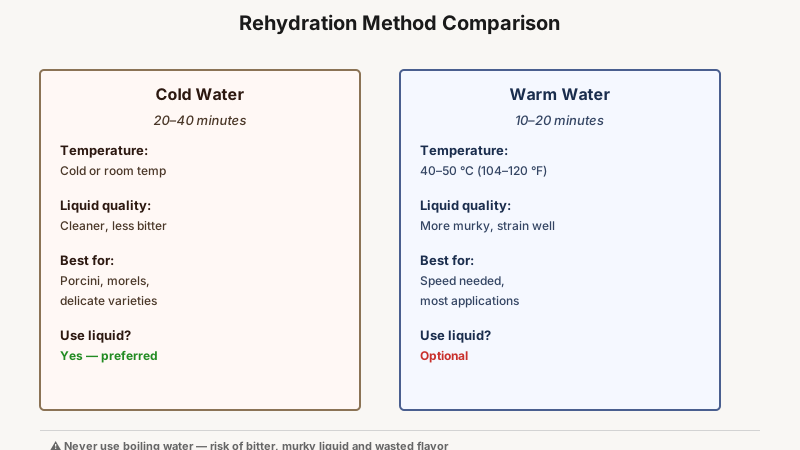
The cold-water method (best for porcini and delicate varieties)
Place the mushrooms in a bowl and cover with cold or room-temperature water. Leave them for 20–30 minutes — porcini slices are usually fully pliable in 20 minutes, while thicker shiitake caps can take 30–40 minutes.
The cold-water method extracts flavor more slowly and, critically, keeps the soaking liquid cleaner and less bitter than hot water does. Several professional kitchens default to this for porcini precisely because the liquid ends up cleaner and more usable.
The warm-water method (faster, fine for most applications)
Cover with water at about 40–50 °C (104–120 °F) — warm but not scalding. This cuts rehydration time roughly in half. Use this when you are in a hurry and plan to strain the liquid anyway.
What NOT to do
- Do not use boiling water. It shortens rehydration time only marginally for most varieties, and it can make the soaking liquid bitter and murky, wasting some of the best flavor you have.
- Do not skip soaking entirely and just simmer in stock. You can do it, but you lose the concentrated soaking liquid as a separate ingredient — which is often the most flavorful thing in your mise en place.
How much water to use
Use just enough to cover, with an inch or so of clearance. Excess water dilutes the soaking liquid unnecessarily. A good ratio for porcini is roughly 25 g dried mushrooms to 350–400 ml water — this produces a concentrated soaking liquid worth using.

Getting Maximum Value from the Soaking Liquid
This step is where most home cooks leave flavor on the table.
Once the mushrooms are tender, lift them out rather than pouring the whole bowl through a strainer. The sediment sinks to the bottom — grit, sand particles, and any bits of forest debris. If you pour, you risk stirring it back up.
Then strain the liquid through a fine-mesh sieve lined with a single layer of paper towel or cheesecloth. What you have now is a mushroom stock — sweet, savory, and complex. It is particularly rich in glutamates and 5’-guanylate (GMP), a nucleotide that synergizes with glutamate to amplify the perception of umami far beyond what either compound achieves alone.
How to use the soaking liquid:
- Add it to risotto in place of some of the stock.
- Stir a few tablespoons into a pan sauce for steak or chicken.
- Use it as the braising liquid for lentils or beans.
- Reduce it by half and add a knob of butter as a quick finishing sauce.
Do not discard it unless you genuinely have no use for it. It freezes well in ice cube trays.
Cooking Rehydrated Dried Mushrooms
After rehydration, the mushrooms still need cooking. They are not ready to eat as-is — they are bloated with absorbed water and need heat to develop any real texture or depth.
Sautéing (the most reliable method)
Pat the rehydrated mushrooms as dry as you can with paper towels. This step is non-negotiable: if they go into the pan wet, they steam instead of brown, and browning is what gives you the roasted, nutty top notes that complement all that umami.
- Heat a pan (carbon steel or cast iron over a regular skillet) until a drop of water skitters away immediately.
- Add neutral oil or clarified butter — whole butter will burn at the temperature you need.
- Place mushrooms in a single layer. Do not crowd them.
- Leave them alone for 2–3 minutes until the bottom browns, then flip.
- Season with salt only toward the end; early salting draws out moisture and inhibits browning.
Porcini and shiitake hold up well to this treatment. Morels are more fragile — a lower heat and gentle toss is better.
Finishing in a sauce or braise
If the mushrooms are going into a braised dish, you can skip the hard sear and simply add them partway through cooking — they will absorb the braising liquid and meld into the background. This is the right call when you want cohesion rather than distinct mushroom bites.
Pairing with other umami ingredients
Because dried mushrooms are already high in umami, they synergize powerfully with other glutamate-rich ingredients: Parmesan, aged soy sauce, tomato paste, anchovies, miso. You do not need all of them at once, but combining two is a legitimate technique — a tablespoon of tomato paste in a porcini risotto, or a miso glaze on shiitake, will read as more complex than the sum of the parts.

If you’re building deeper flavor by combining pantry staples like these mushrooms with other savory ingredients, Cook With What You Have: A Practical Pantry Guide offers a broader framework for that kind of resourceful cooking.
Practical Recipes and Serving Ideas
Rather than full recipes, here are use-cases that illustrate what each variety does best.
Porcini pasta: Sauté rehydrated porcini in butter, deglaze with the soaking liquid, reduce until nearly syrupy, toss with al dente tagliatelle, a handful of Parmesan, and a splash of pasta water. Fifteen minutes of active cooking, but the flavor reads like something that took much longer.
Shiitake and ginger broth: Simmer shiitake soaking liquid with kombu, a coin of fresh ginger, and a spoonful of light soy. Strain, add the rehydrated shiitake caps back in, and finish with a few drops of sesame oil. The GMP in the shiitake and the glutamate in the kombu combine to make a broth that tastes far more elaborate than it is.
Morel cream sauce: Gently sauté morels in butter, add a splash of dry sherry, reduce, add a small amount of heavy cream, and simmer until slightly thickened. Season carefully. This is a sauce that belongs on grilled fish, roasted chicken, or even a thick slice of brioche toast.
Storing Unused Rehydrated Mushrooms
Once rehydrated, mushrooms are perishable. Store them covered in the fridge and use within two to three days. If you have rehydrated more than you need immediately, you can freeze them, but expect some texture loss — they will be better suited to cooked applications than to dishes where chew matters.
Dried mushrooms themselves, stored in an airtight container away from light and moisture, keep comfortably for a year or more without meaningful quality loss.
For more tips on handling other pantry and freezer staples without losing texture, check out How to Cook Frozen Vegetables Without Sogginess.
Frequently Asked Questions
Does the type of water affect the soaking liquid?
Hard, heavily chlorinated tap water can introduce off-flavors, though in practice the effect is subtle. If your tap water tastes strongly of chlorine, filtered water is worth using here.
Can I reuse the soaking liquid as a base multiple times?
Not in the way you would a stock pot. The liquid is one-use — once strained and applied, it is spent. But it freezes well as a flavor booster for a future dish.
My rehydrated mushrooms still seem rubbery after cooking. What went wrong?
Usually under-rehydration — the center never fully absorbed water. With thick shiitake caps, give them a full 30–40 minutes even in warm water, or score the caps lightly with a knife before soaking to speed absorption.
Are the nutrients in dried mushrooms comparable to fresh?
Drying concentrates some minerals and preserves most B vitamins reasonably well, though exact retention varies by drying method and storage conditions. The flavor compounds — glutamates and nucleotides — are either preserved or concentrated, which is the more relevant point for cooking.
Can dried mushrooms replace fresh mushrooms 1:1 in a recipe?
Not by weight. A common starting point is roughly 1 part dried to 6–8 parts fresh by weight, but this varies by mushroom and dish. It is better to think of them as different ingredients that share a category rather than strict substitutes — dried mushrooms bring concentrated flavor and a soft-firm texture; fresh bring moisture and a lighter, brighter character.