Fix Common Cake Baking Mistakes Before They Ruin Your Bake

Why Cakes Go Wrong — and How to Read the Clues
Baking a cake is part chemistry, part technique, and part timing. When it fails — a sunken center, a dense crumb, a crust that peels away — the problem almost always traces back to one specific step, not some vague general carelessness. The good news is that most cake mistakes follow recognizable patterns. Once you know what to look for, you can both prevent the failure and, in some cases, salvage the bake.
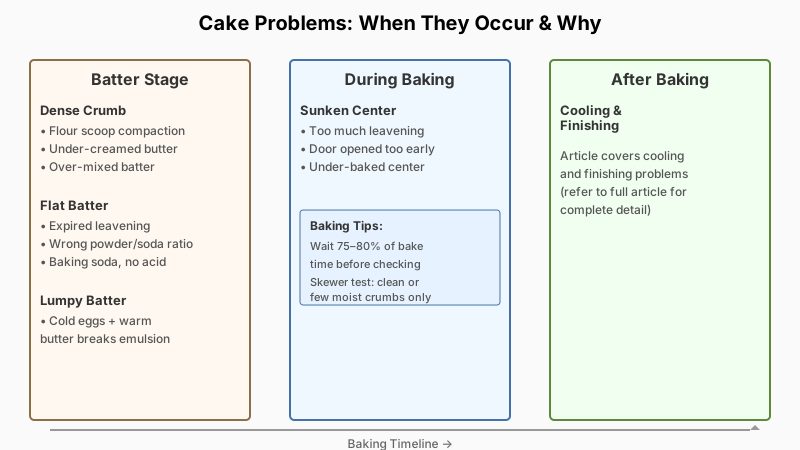
This guide covers the most common problems in order of when they appear: batter stage, rise and bake, then cooling and finishing. Within each, you’ll find the real cause (not just the usual oversimplification), how to prevent it, and what to do if it’s already happened.

Problems at the Batter Stage
Dense or Heavy Crumb
A dense cake usually means one of three things: too much flour, under-creaming the fat and sugar, or over-mixing once the flour goes in.
Too much flour is the most common culprit, and it’s almost always a measuring issue. When you scoop flour directly with the measuring cup, you compact it — a single “scoop” can weigh anywhere from 120 g to 170 g depending on technique, even though the standard cup measure assumes roughly 125 g. The fix is to spoon flour into the cup and level it off, or better yet, weigh it with a scale.
Under-creaming is subtler. Creaming butter and sugar together isn’t just mixing — it’s mechanically incorporating tiny air bubbles that expand in the oven and give the cake its lift. Most recipes call for 3–5 minutes on medium-high speed. If you stop when the mixture looks “combined,” you’ve likely stopped 2 minutes early. The batter should be noticeably pale and fluffy, almost like soft whipped butter, before you move on.
Over-mixing after flour is added activates gluten and toughens the crumb. Once you see flour, mix on low speed and stop the moment the batter looks uniform. A few streaks are fine — they disappear during folding. If you’re folding by hand, use wide, slow strokes.
Inaccurate measuring is often to blame here, so Best Kitchen Scales for Baking: How to Choose and Use One is worth a look if you’re still eyeballing ingredients.
Flat Batter That Doesn’t Rise
Flat cake almost always points to leavening: either expired baking powder, wrong quantities, or baking soda without enough acid to activate it.
Test baking powder before a bake: drop a teaspoon into hot water. If it bubbles vigorously, it’s still active. Baking soda requires an acidic ingredient (buttermilk, yogurt, brown sugar, cocoa, citrus juice) for most of its lift. If a recipe calls for baking soda but you’ve substituted regular milk for buttermilk, you’ve removed the acid and the lift will suffer — reduce the soda and add a small amount of baking powder to compensate.
Also check ratios. In most standard cake formulas, roughly 1 teaspoon of baking powder per 125–130 g flour is a reliable starting range, but the actual requirement depends on your other ingredients — a recipe with a lot of eggs may need less. When in doubt, trust tested recipes over improvised ones.
If you’re unsure whether the culprit is your leavening agent, Baking Soda vs Baking Powder: Key Differences Explained explains how these two common ingredients behave differently in your batter.
Lumpy or Curdled Batter
Batter that looks curdled — with visible lumps of butter in a watery liquid — usually means your eggs were added cold into room-temperature butter. The fat seizes around the cold egg and the emulsion breaks.
Prevent this by taking eggs out of the fridge 30–45 minutes before baking. If the batter does curdle, add a tablespoon of flour and mix briefly; this often brings it back together. The baked cake may still be slightly uneven in texture but it won’t be a disaster.
Problems During Baking
Cake Sinks in the Middle
A center that drops after (or during) baking is one of the most frustrating sights in baking. The most common causes:
- Too much leavening. Counterintuitively, too much baking powder or soda causes the cake to rise fast, then collapse because the structure can’t set before the bubbles escape. More isn’t better.
- Opening the oven door too early. The structure of a cake sets in the last third of its bake time. Opening the oven before that point lets in cold air and can cause collapse. Wait until at least 75–80% of the stated bake time has passed before checking.
- Underbaking. A center that falls after the cake comes out of the oven usually means the interior wasn’t fully set. Test doneness by inserting a skewer into the thickest point — it should come out clean, or with just a few moist crumbs (no wet batter).
If the cake has already sunk: a deep enough dip can be filled with frosting, compote, or whipped cream and leaned into as a design feature. For slight dips, leveling the cake with a serrated knife before layering it solves the problem invisibly.

Cake Rises Unevenly or Domes Sharply
A dramatic dome or cracked top means the oven is too hot — the edges set and the center keeps rising alone, cracking the surface.
Lower your oven temperature by 10–15 °C and add 5–10 minutes to the bake time. A damp cake strip (a strip of wet fabric wrapped around the pan) insulates the sides and encourages more even rising — many professional bakers use them routinely. You can buy purpose-made ones or improvise with strips of old towel secured with a safety pin.
If even-top layers matter for stacking, baking at 160–165 °C (fan) rather than 180 °C (fan) almost always produces a flatter cake, though your total bake time will be longer.
Burnt Edges, Pale Centre
This typically means the oven runs hot at the edges — common with dark-colored metal pans and older ovens with uneven heating elements. Solutions:
- Use light-colored aluminum or anodized pans. Dark pans absorb more radiant heat and can overbrown the outer crust before the center sets.
- Place pans on the middle rack, not near the top or bottom element.
- If burning is persistent, place a second empty baking tray on the rack below to diffuse heat from underneath.
Sticking to the Pan
Greasing alone often isn’t enough, especially with intricate bundt or tube pans. Grease the pan, then dust with flour — tap out the excess. For chocolate cakes where the white flour dusting shows, use cocoa powder instead. Lining the base of round cake pans with parchment after greasing is the most reliable insurance for flat-based cakes.
If a cake has stuck, run a thin-bladed offset spatula around the edges while the cake is still slightly warm (not hot). Turn it out onto a rack. If a section tears, let it cool completely, then use frosting as mortar to press it back together — once decorated, no one will know.
Problems After Baking: Texture, Crust, and Decoration
Dry, Crumbly Texture
Dryness after baking usually points to one of two things: overbaking or too little fat.
Overbaking is common in home ovens because most domestic ovens run hotter than their dial indicates — sometimes by 15–25 °C. An inexpensive oven thermometer is one of the highest-return tools you can add to your kitchen. It removes guesswork and often solves recurrent dryness in one purchase.
If the fat ratio was correct but the cake dried out during storage, wrapping it tightly in clingfilm (plastic wrap) while still slightly warm traps steam and keeps it moist. A day wrapped is often enough to soften a slightly over-baked cake considerably.
Soggy or Gummy Bottom
A gummy bottom usually means underbaking near the base, or the batter is wetter than intended because of ingredient swaps (substituting low-fat dairy, for instance, or adding too much fruit).
Ensure the pan is properly preheated (put it in the oven while it heats up for 5 minutes before adding batter, especially for dense batters). If the problem persists, move the rack one level lower so the base gets more direct heat.
Frosting or Glaze Won’t Set
Buttercream that slides off or ganache that stays runny both come down to temperature. Buttercream should be applied to a cake that has cooled to room temperature — a warm cake melts the fat. Ganache sets because cocoa butter crystallizes as it cools; if yours stays liquid, the cream-to-chocolate ratio may be too high, or the chocolate wasn’t stirred long enough as it cooled (stirring promotes crystallization).
For a quick rescue: chill the cake (with a loose crumb coat on) for 15–20 minutes before applying the final layer. For ganache that won’t set, add a small amount of additional melted chocolate, stir well, and let it cool further.

Sunken Fruit or Chocolate Chips
Fruit, nuts, and chocolate chips sink when the batter is too thin or too loose to hold them. The classic fix: toss fruit or chips lightly in flour before folding them in. The flour coating helps them grip the batter. You can also reserve a third of the batter, pour it in first, scatter the add-ins, then top with the remaining batter — this suspends them in the middle of the cake, which is often where you want them anyway.
Frequently Asked Questions
Why does my cake taste eggy even though I followed the recipe?
Usually this means the eggs were large rather than medium (or vice versa) and the recipe wasn’t adjusted, or the cake was slightly underbaked. Eggy flavor also intensifies if the cake is eaten while still warm — let it cool completely, and the flavor usually mellows noticeably.
Can I substitute oil for butter (or vice versa) in a cake recipe?
You can, but the results differ. Oil produces a moister, denser crumb because it stays liquid at room temperature; butter produces more flavor and a slightly firmer crumb. As a rough swap, use about 75–80% as much oil as the butter weight called for (butter is about 80% fat; oil is 100%). Recipes designed for creaming method don’t convert well to oil — the technique changes, not just the ingredient.
My cake sank and I can’t salvage it as a layer cake. What now?
Crumble it into cake pops or a trifle. Both disguise texture problems completely and often taste better than the original plan. A dense, slightly underbaked center is actually ideal for the rich, fudgy base of a trifle.
Why does my cake stick even though I greased the pan?
Grease alone forms a thin barrier that breaks under extended heat. Always grease AND flour (or grease and line with parchment). The exception: very high-fat recipes (like some pound cakes) may release cleanly with just thorough greasing, but adding flour costs nothing.
How do I know if my oven temperature is accurate?
Buy a standalone oven thermometer — they cost very little and hang or sit on the oven rack. Check it against your dial setting at baking temperature after 20 minutes of preheating. Many home ovens are off by 10–25 °C, which explains a huge proportion of recurrent baking failures.
The Shortest Path to Better Cakes
Most cake problems aren’t random — they’re systematic. If your cakes consistently sink, or consistently burn on the outside, the same underlying cause is repeating. Weigh your ingredients, trust an oven thermometer over the dial, and match your mixing method to the recipe rather than improvising. These three habits resolve the majority of cake failures before they start. The rest — fruit that sinks, frosting that won’t set — are fixable in the moment once you know which lever to pull.
Sources
- https://www.seriouseats.com/baking-by-weight-volume
- https://www.seriouseats.com/baking-soda-baking-powder-differences
- https://www.thekitchn.com/oven-thermometer-baking-23004484
- https://pmc.ncbi.nlm.nih.gov/articles/PMC10001083/ — Impact of Baking Powder and Leavening Acids on Batter and Pound Cake Properties (Foods, 2023)