Best Kitchen Scales for Baking: How to Choose and Use One

A kitchen scale is the single most reliable upgrade you can make to your baking. Flour scooped into a cup can weigh anywhere from 110 g to 160 g depending on how you pack it — a 45% swing that explains more failed loaves than any bad recipe. Weight-based measuring closes that gap completely.
This guide covers what to look for in a baking scale, which types suit different situations, and how to use one so your baking actually improves.

Why Weight Beats Volume in Baking
Baking is closer to chemistry than cooking. Bread hydration ratios, cake crumb texture, and cookie spread all depend on precise ingredient ratios. A cup of almond flour packs nearly twice as dense as a cup of all-purpose flour. Cocoa powder settles; brown sugar clumps. Volume measurements for dry ingredients are inherently inconsistent.
Grams remove the variable. Once a recipe is written by weight, it reproduces reliably regardless of altitude, humidity, or whether you sifted first. Professional bakers use baker’s percentages — all ingredients expressed as a percentage of flour weight — precisely because weight is stable and scalable in a way cups never can be.
For liquids, weight is also faster than measuring cups for anything thick (honey, molasses, tahini) because you can zero out and pour directly into the mixing bowl.
If you’re not ready to invest in a scale just yet, How to Properly Measure Flour for Baking: Spoon In, Level Off explains how to get closer to accurate measurements using cups and spoons.
What to Look For: Key Features Explained
Capacity and Resolution
Most home baking scales read from 1 g (or 0.1 g for precision work) up to 3–5 kg. For bread baking — where you might weigh 1 kg of flour and then a pinch of yeast in the same session — you need a scale that is both high-capacity and fine-grained. Many budget scales max out at 5 kg with 1 g resolution, which covers most needs. If you work with small quantities of salt, leavening agents, or spices, consider a scale that offers 0.1 g resolution, or keep a separate small jeweler’s scale for micro-ingredients.
Tare Function
Every decent baking scale has a tare button (sometimes labeled “Zero”). It lets you zero out the weight of your bowl, add ingredients sequentially, and zero again between each one — so you measure everything directly into the working vessel. This is the feature that saves the most time and washing up.
Platform Size
A narrow platform is inconvenient for large mixing bowls. Look for a platform at least 15 cm × 15 cm if you regularly bake with 3–4 litre bowls.
Response Time and Stability
A scale that takes 3–4 seconds to settle on a reading becomes annoying fast. Good scales stabilize in under 1–2 seconds even when you’re adding flour incrementally. Look for reviews that mention “settle time” — it matters more in practice than raw accuracy for most baking.
Display Visibility
Backlit displays are useful in dim kitchens. The display should be large enough to read while standing over it with a bowl in the way — some flat designs hide the screen under the bowl edge.
Power
Battery-operated scales (usually 2× AAA) are the standard. Some rechargeable USB-C models are emerging, which reduce battery waste. Auto-off timers (typically 3–5 minutes of inactivity) preserve battery life but can be annoying mid-recipe; look for a longer auto-off setting or a model where you can disable it.
Build and Cleanup
A flat stainless-steel or tempered-glass platform wipes down quickly. Scales with raised lips or crevices around the platform collect flour. Avoid platforms with exposed screw holes or rubber gaskets if cleanliness is a priority.

Types of Kitchen Scales for Baking
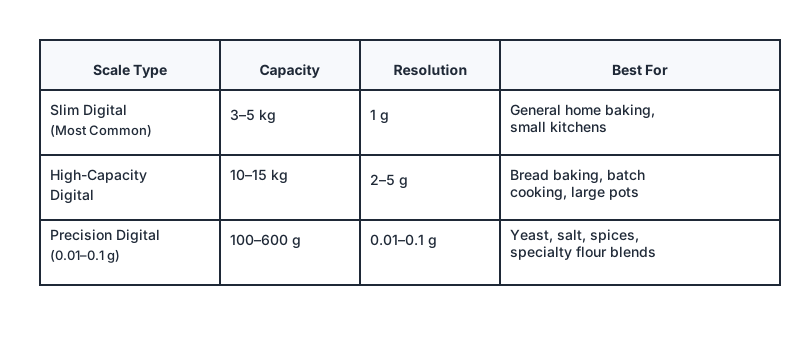
Slim Digital Scales (Most Common)
These are the flat, disc- or slab-shaped scales found in most kitchens. They’re compact, affordable, and accurate enough for everyday baking. Resolution is typically 1 g; capacity 3–5 kg. The main compromise is settle time and platform size.
Best for: general home baking, small kitchens, occasional use.
High-Capacity Digital Scales
Designed for bread bakers, pizza dough makers, and anyone working with large batch sizes. Capacity runs to 10–15 kg. Resolution may drop to 2 g or 5 g at higher weights, which matters less once you’re measuring kg quantities.
Best for: bread baking, batch cooking, weighing large pots.
Precision Digital Scales (0.01 g – 0.1 g Resolution)
Originally lab and jeweler’s tools, these have found a home among bread bakers obsessing over yeast additions, fermentation salt percentages, and spice blends. Capacity is usually low (100–600 g), so you can’t use them as your primary scale. They’re a complement, not a replacement.
Best for: weighing yeast, salt, baking powder, spices, specialty flour blends.
Analog (Mechanical) Scales
Spring-based scales without electronics. They never need batteries and can last decades. Accuracy is lower (typically ±5 g) and they can drift if the spring weakens. For casual baking where repeatable precision matters less, they’re perfectly functional and aesthetically appealing. Don’t rely on them for lean-dough bread or pastry.
Best for: casual baking, rustic recipes, zero-battery reliability.
Top Kitchen Scales Worth Considering
Here are five scales that consistently receive high marks from bakers across different needs and budgets. Prices vary by retailer and region — check current listings.
OXO Good Grips 11-pound Stainless Steel Scale is a perennial favourite for good reason. The pull-out display solves the bowl-hiding-the-screen problem neatly, and the stainless platform cleans well. Resolution is 1 g; capacity roughly 5 kg.
Escali Primo is a compact, lightweight option with a simple one-button operation. It’s inexpensive, accurate to 1 g, and holds up to 11 lb / 5 kg. The platform is smaller than the OXO but fine for most home baking bowls.
Ozeri Pronto Digital Multifunction Kitchen Scale covers 0.1 g to 11.34 kg, offers unit switching (g, oz, lb, kg, ml), and has an unusually clear display for its price point. A solid all-rounder at the budget end.
AWS AWS-1KG-BLK is a precision scale (0.1 g resolution, 1 kg capacity) suited to weighing small ingredients. Pair it with a larger scale for full baking sessions.
Etekcity Food Kitchen Scale offers reliable 1 g resolution in a slim profile with a large stainless platform. Its auto-off can be long enough (usually 5 minutes) not to interrupt most recipes.

How to Use a Kitchen Scale to Improve Your Baking
Zero Before Every Ingredient
Place your bowl on the scale, press tare, and add the first ingredient. Before the next ingredient, press tare again. This eliminates cumulative errors and means you can work directly from the recipe without any mental arithmetic.
Convert Your Favourite Recipes to Weight
If you have recipes you trust that use volume measures, weigh each ingredient once (cup of your flour = X grams in your kitchen with your brand), note it, and write the weights into the recipe for next time. You’ll get more consistent results from the third bake onward.
For a recipe that truly rewards precise weighing, try How to Bake Sourdough Bread from Scratch: One Living Starter, No Yeast, where accurate hydration and flour measurements make all the difference.
Use a Scale for Portioning
Equal-weight cookie dough balls bake more evenly than scooped ones. Divide cake batter by weight across tins to get level layers. Weigh pizza dough balls to get consistent individual portions.
Don’t Bake Off the Scale
A common mistake: weighing ingredients accurately, then leaving the scale in the cupboard for the next recipe. Keep it on the counter. The moment it becomes a default step rather than an occasional one, your results stabilize noticeably.
Calibration and Maintenance
Digital scales use internal strain gauges and should maintain calibration well under normal use. However, dropping a scale can shift calibration. Test yours occasionally with a known weight — a sealed 100 g calibration weight, or a reliable object you’ve verified on another scale. Many precision scales include a calibration mode; budget scales usually don’t.
Store scales flat, not on their side. Avoid storing heavy objects on the platform. Clean the platform after each use — dried honey is surprisingly hard on load cells over time.
Frequently Asked Questions
Do I really need a kitchen scale for baking, or are measuring cups fine?
For casual baking — a banana bread here, a batch of cookies there — cups work. For anything where consistency matters (sourdough, macarons, chiffon cakes, croissants), a scale is genuinely necessary. The more technically demanding the recipe, the faster a scale pays for itself in fewer failed batches.
What unit should I use — grams or ounces?
Grams are almost universally preferred by professional and serious home bakers because the numbers are larger, which makes small errors more visible (a 2 g mistake in a 500 g flour weight is 0.4%; a fraction-of-an-ounce mistake is harder to notice). Switch to ounces only if all your recipes are written that way.
How accurate does a baking scale really need to be?
For flour, sugar, and butter, 1 g resolution is more than adequate. For leavening agents (baking powder, baking soda, instant yeast), the quantities are small enough that 1 g can be a 20–50% error; use a 0.1 g precision scale for these or use volume measures as a fallback.
My scale gives slightly different readings if I move the bowl — is it broken?
Not necessarily. Many scales are sensitive to where on the platform the load sits, especially cheap or older models. Consistently centering your bowl minimises this. If readings vary by more than 2–3 g with the same load, the scale may have a faulty or uneven load cell.
Can I use my kitchen scale to measure liquids?
Yes. Water is almost exactly 1 g per ml, so 250 ml water = 250 g. Most baking liquids (milk, cream, juice) are close enough to water’s density that the same conversion works within rounding error. Oils are lighter (about 0.92 g/ml) and thick syrups are heavier — for high-precision pastry work, look up the specific density or use volume for these.