Best Manual Coffee Grinders for Home: Grind Quality Over Hype

Manual coffee grinders occupy a peculiar sweet spot in the world of home brewing: they cost a fraction of what a quality electric grinder runs, produce grind quality that matches or exceeds far pricier machines, and fit in a jacket pocket. The trade-off is obvious — you’re the motor. Whether that trade-off is worth it depends entirely on how you brew and how much coffee you make at once.
This guide breaks down what actually separates a good manual grinder from a mediocre one, covers the formats and burr types you’ll encounter, and walks through specific models worth considering across a range of budgets.
What Makes a Manual Grinder Worth Buying
Burr quality is almost everything
Two burrs — the metal (or ceramic) discs that crack and grind beans — determine the flavor of your cup more than nearly any other single component. Cheap grinders use thin, poorly-hardened steel that deflects under resistance and produces an uneven particle distribution: some gritty coarse chunks, some fine dust. Good burrs cut cleanly and consistently, producing a tight particle distribution that extracts evenly and lets you actually taste what the roaster intended.
Steel burrs and ceramic burrs both work well, but steel tends to hold its edge longer and cuts faster with less effort. Ceramic burrs are harder to chip but can fracture if a small stone makes it into your beans — a rare but real failure mode.
Burr size and grinding effort
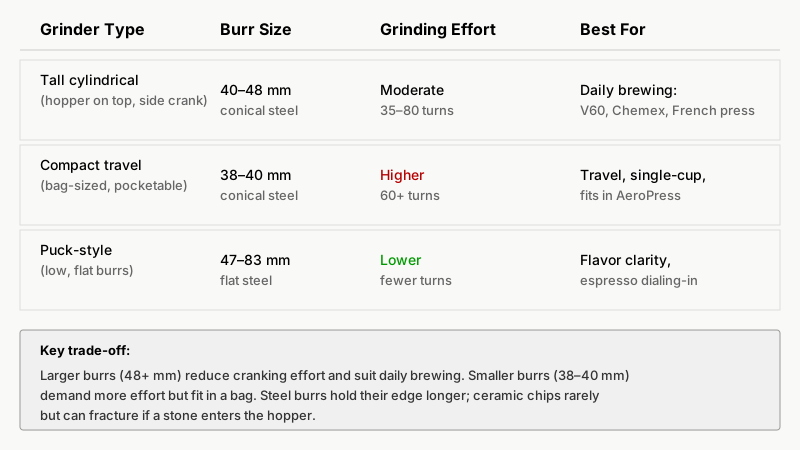
This is the spec nobody talks about loudly enough. A 38 mm burr set requires noticeably more cranking force per gram of coffee than a 48 mm set because smaller burrs need more rotations to process the same mass. For a 15-gram espresso dose, that difference can mean 60 turns versus 35. If you’re grinding 25–30 grams for a V60 every morning, burr diameter matters more than almost anything else on the spec sheet.
Grind adjustment systems
Click-based adjustment (detents) makes repeatability easy — you count clicks and return to the same position without hunting. Stepless adjustment gives finer control at the cost of having to mark your own reference points. For espresso dialing-in, stepless is genuinely useful. For pourover and press brewing, good-quality click adjustment is usually sufficient.
Once you’ve dialed in the right burr and adjustment setup, the next variable to master is timing, which we cover in How to Brew Better Coffee at Home: Why Grind Timing Beats Bean Price.
Retention and static
Manual grinders with a catch cup rather than a grounds chamber tend to have very low retention (often under 0.1 g). Static cling is a separate irritant: titanium-coated burrs or certain plastic cup materials generate more static than others. Running a drop of water over the beans before grinding (the “Ross Droplet Technique” or RDT) eliminates almost all static and costs nothing.

Manual Grinder Formats: Which One Fits Your Life
Tall cylindrical grinders
The classic form factor — a hopper on top, a crank on the side or top, a catch cup below. These are stable on a countertop, easy to hold, and easy to find in every price range. Most of the market lives here. The main ergonomic downside is that side-crank models can feel awkward when loaded with a larger dose.
Compact travel grinders
Slimmer, shorter, and designed to fit in a bag. The 1Zpresso ZP6 Special and the Timemore Nano are examples of this type. Burr diameter is typically smaller (38–40 mm), so grinding effort per gram is higher, but for single-cup travel brewing they’re excellent. Some compact models are short enough to sit inside an AeroPress, making them genuinely pocketable systems.
Puck-style / flat-burr manual grinders
A newer category: large-diameter flat burrs (47–83 mm) in a low, cylindrical “puck” housing. The Comandante P series and the Weber Key are the most-discussed examples. Flat burrs produce a different particle shape than conical burrs — some brewers find the cup character slightly different (often described as more clarity and separation of flavor), though this is subtle and subject to the brewer’s preferences and technique. These grinders are larger, heavier, and considerably more expensive than cylindrical models.
The Best Manual Coffee Grinders for Home, by Category
Best overall: 1Zpresso J-Max S
The 1Zpresso J-Max S is, by a wide margin, one of the most capable manual grinders available. It uses a 48 mm conical steel burr set with a very fine stepless external adjustment ring — the ring clicks in 0.1 mm increments, giving you precise control across an exceptionally wide range, from coarse French press to very fine espresso. Grind quality at the coarser settings is excellent; for espresso, it produces consistent enough results to dial into a shot without frustration, which is genuinely rare in manual grinders under $200.
The body is machined aluminum, feels substantial without being heavy, and the top-mounted crank is ergonomically effective for larger doses. Expect roughly 30–40 turns for a 20-gram espresso dose.
Best mid-range all-rounder: Timemore Chestnut C3S Pro
Timemore has become the value benchmark in manual grinding, and the C3S Pro is the most refined version of their mid-range conical. It uses a 38 mm steel burr, which means it’s better suited to pourover and AeroPress doses (15–20 g) than to full espresso double shots. The grind consistency at the medium-coarse range is genuinely competitive with machines costing several times more. The body is clean, the crank folds for compact storage, and the price lands well under $100 — making it an easy first serious grinder recommendation.
Best for espresso only: 1Zpresso ZP6 Special
If your daily brew is a single or double espresso — nothing else — the ZP6 Special is worth serious consideration. It uses a 38 mm burr set specifically optimized for fine grinds, with a stepless magnetic adjustment system that clicks in very small increments and makes dialing in repeatable. It grinds fine faster than most conicals of the same size because the burr geometry is tuned for that range. The body is compact enough to slip into a jacket pocket.
Best premium upgrade: Comandante C40 MK4 Nitro Blade
The Comandante C40 is the grinder that turned the specialty coffee world onto the idea that a hand grinder could be a serious tool. The MK4 uses Comandante’s proprietary high-nitrogen steel burrs — the “Nitro Blade” — in a 40 mm conical set. What distinguishes it isn’t just grind consistency (which is very good) but build quality: the body is solid stainless steel or high-grade resin depending on the model, and the mechanism has virtually zero wobble. The C40 MK4 grinds consistently across its full range, from aeropress to chemex, and holds its adjustment reliably. It’s not optimized for espresso as precisely as the J-Max S, but for filter coffee it’s hard to beat.
Best budget pick: Hario Skerton Pro
For anyone spending under $50, the Hario Skerton Pro is the honest recommendation. It uses ceramic burrs and a stabilized lower burr shaft (an improvement over the original Skerton, which wobbled noticeably). Grind quality at coarser settings for French press and drip is perfectly acceptable. Espresso is inconsistent. The catch jar is large enough for 30-gram doses. It won’t make you love grinding, but it makes a respectable cup and it’s genuinely durable — some have used the same Skerton for five-plus years without burr replacement.

Best puck-style flat-burr: Weber Key
For the home brewer who wants to explore what a large-diameter flat burr does to a cup, the Weber Key is one of the most refined options available. Its 83 mm flat stainless steel burr set is larger than some commercial electric grinders. The grind output is strikingly uniform across particle sizes. It is, however, expensive and requires more physical effort than a conical — flat burrs create more resistance because they process the entire bean face simultaneously rather than in a progressive conical feed. It’s a passion purchase for someone who cares deeply about extraction clarity and has already worked through the basics.
Brewing Method and Grinder Pairing, Simply Put
- French press, cold brew (coarse): Any grinder with a stable coarse setting works. The Skerton Pro and C3S Pro are both fine here.
- Pourover, drip, Chemex (medium-coarse to medium): This is where the sweet spot for most manual grinders sits. C3S Pro, C40 MK4, J-Max S all excel.
- AeroPress, Moka pot (medium to medium-fine): Flexible — most grinders listed handle this well.
- Espresso (very fine, high pressure): The J-Max S or ZP6 Special. Espresso demands the finest, most consistent grind; burr diameter and adjustment precision matter most here.

If you’re still deciding which brewer to pair your new grinder with, 7 Best Coffee Brewing Methods at Home, Ranked breaks down the options side by side.
Care, Maintenance, and Realistic Expectations
Conical steel burrs in home use typically last several years before you notice any performance degradation — for a home brewer consuming 250–500 grams of coffee per week, burr replacement (where available as a spare part) is realistically a once-every-few-years event, not a frequent cost.
Washing the burrs occasionally with warm water and a brush removes oily buildup that can turn rancid and affect flavor. Let all parts dry completely before reassembling — rust is rare with modern stainless burrs but not impossible if water sits in the housing.
Grinder tablets (such as Grindz) are designed for electric grinders and are unnecessary and potentially damaging for most manual grinders. A small, stiff brush is the correct tool.
One thing worth calibrating expectations around: the grind range markers on most manual grinders are guidelines, not absolutes. “Espresso position” on one bag of beans may produce a channeling shot and need to be adjusted finer on the next. The adjustment system is there to be used; dial in for each new bag of beans, not once and then never again.
Frequently Asked Questions
Are manual grinders actually better than electric grinders at the same price?
For grind quality per dollar, yes — generally. A $150 manual grinder typically uses higher-grade burrs than a $150 electric, because the electric has to budget for a motor, housing, hopper, and electronics. The trade-off is time and physical effort. At the $300+ price point, quality electric grinders (like the Niche Zero or Fellow Opus) begin to match the value proposition of manual options.
How long does it take to grind coffee with a manual grinder?
For a single pourover dose (15–18 g), expect 45–90 seconds depending on grind size and burr diameter. For an espresso double (18–20 g at fine grind), expect 60–120 seconds with a mid-range conical. Larger-burr grinders like the J-Max S run noticeably faster than smaller-burr options.
Can I use a manual grinder for espresso at home?
Yes, but the grinder must support a fine, consistent grind — not all manual grinders do. The 1Zpresso J-Max S and ZP6 Special are specifically suited for this. Standard drip-oriented grinders (Skerton Pro, entry-level Timemores) will produce an inconsistent espresso grind.
How do I know when burrs need replacing?
The clearest sign is that your usual grind setting stops producing the same result: shots pull faster than before at the same setting, or pourover channeling increases. A secondary sign is visible wear or chipping on the burr edges. For home use on quality steel burrs, this is uncommon within the first three to four years of normal use.
Is a manual grinder practical for making coffee for two people?
Doable, but notice the effort. Grinding 30–36 grams (two standard pourover doses) with a 38 mm burr takes close to two minutes. With a 48 mm burr (J-Max S, C40 MK4) it’s faster — around 60–80 seconds. If you’re brewing for two daily, consider whether a quality entry-level electric grinder might serve you better long-term.
Final Thoughts
Manual grinding isn’t a compromise — for single-cup brewing, it’s one of the cleanest ways to get high-quality, consistent grounds without spending $400 on an electric burr grinder. The best option depends on your brew method, your dose size, and your budget. For most home pourover brewers, the Timemore C3S Pro is genuinely hard to beat at its price. Step up to the 1Zpresso J-Max S if you want range that covers espresso too, or to the Comandante C40 MK4 if long-term build quality and resale value matter to you.
Grind quality is one of the highest-leverage variables in home coffee. A good manual grinder is a cheap way to access it.