How to Rest Meat After Cooking: Texture & Juiciness Guide

Cut into a steak straight off the grill and you’ll see a small flood of juice pool onto the cutting board. Wait five minutes, slice again, and barely a drop escapes. That difference — all from waiting — is one of the most reliable improvements you can make to nearly every meat dish you cook. Resting isn’t superstition or chef theater. It’s basic muscle-fiber science, and once you understand what’s actually happening, you’ll never skip it again.
Why Resting Meat Matters: The Science Behind the Pause
Meat is mostly water bound inside muscle fibers. During cooking, heat causes those fibers to contract forcefully, squeezing liquid toward the center of the cut. Think of it like wringing a wet cloth — the tension pushes everything inward.
When you pull the meat off the heat, the outer fibers begin to relax. Over the next few minutes, that central moisture redistributes outward, reabsorbing into the surrounding muscle tissue rather than pooling on your cutting board. The result: every bite holds more liquid, which registers as juiciness.
There’s a secondary effect worth knowing: carryover cooking. The exterior of a thick roast can be 20–30°F (11–17°C) hotter than its center the moment you remove it from the oven. During resting, that residual heat continues to travel inward, gently finishing the cook. For a roast you pull at 125°F (52°C), the internal temperature might climb to 130°F (54°C) while it rests — a meaningful shift if you’re targeting medium-rare.
So resting serves two distinct purposes at once: it improves moisture retention and it lets the temperature equalize for a more even, consistent texture from edge to center.

Good results start well before the pan, so it helps to also get the front end right with How to Defrost Frozen Meat Safely: Stop Bacteria in Its Tracks.
How Long to Rest: A Practical Guide by Cut and Protein
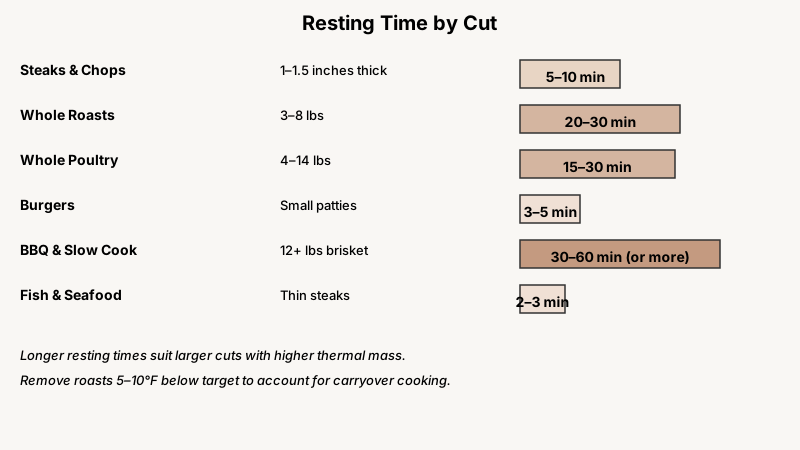
Resting time scales with mass. A thin chicken breast needs far less recovery time than a 6-pound leg of lamb. Here’s a cut-by-cut breakdown:
Steaks and Chops (1–1.5 inches thick)
- Resting time: 5–10 minutes
- Why it works: The relatively thin cross-section means heat has less distance to redistribute. Five minutes is usually plenty for a ribeye or pork chop; a thick 1.5-inch New York strip benefits from closer to 8–10 minutes.
- Method: Tent loosely with foil and set on a warm plate or cutting board.
Whole Roasts and Large Joints (3–8 lbs)
- Resting time: 20–30 minutes
- Why it works: A beef prime rib or a pork shoulder has a much larger thermal mass. The interior temperature can still be rising for 10–15 minutes after removal from the oven, and the fibers take longer to fully relax.
- Tip: Remove the roast from the oven 5–10°F below your target temperature to account for carryover. A prime rib targeted for 130°F (medium-rare) should come out at around 120–122°F.
Whole Poultry (Chicken, Turkey, Duck)
- Resting time: 15–30 minutes depending on size
- Why it works: A whole roast chicken (roughly 4 lbs) rests well for 15 minutes. A 14-pound turkey needs closer to 30 minutes. Poultry must reach a safe internal temperature of 165°F (74°C) as measured in the thickest part of the thigh; resting doesn’t bring it up to safety from an undercooked state — it simply evens out the texture once the bird has hit temperature.
- Bonus: The skin firms back up slightly during resting if you leave it uncovered, which preserves crispness.
Burgers and Small Patties
- Resting time: 3–5 minutes
- A burger rested on a rack for even a few minutes will be noticeably juicier than one sliced immediately. Small mass means small window, so don’t overthink it.
BBQ Brisket and Pulled Pork (Low-and-Slow Cuts)
- Resting time: 30–60 minutes (or longer)
- Competition pitmasters commonly rest brisket for 1–2 hours wrapped in butcher paper inside a dry cooler. The dense collagen-rich tissue is still breaking down and redistributing even off the heat. A 12-hour smoked brisket deserves at least 45 minutes of rest — cutting it early wastes the entire cook.
Fish and Seafood
- Resting time: 2–3 minutes only
- Fish has delicate, short muscle fibers that release liquid quickly. Brief resting — just long enough to carry over — is all that’s needed. Salmon and tuna steaks benefit from 2–3 minutes off heat. Most shellfish is served immediately.
How to Rest Meat Properly: Surface, Wrap, and Environment
The technique matters nearly as much as the timing. Here’s what actually works:
Surface: Rack vs. Plate vs. Cutting Board
- A wire rack set over a baking sheet is ideal for large roasts and poultry. Air can circulate underneath, preventing the bottom from steaming and going soggy.
- A wooden cutting board works well for steaks and chops. Wood is a mild insulator and absorbs almost no heat from the meat, unlike a cold marble slab, which can accelerate cooling unevenly.
- Avoid cold metal surfaces — a chilled stainless steel sheet pan will pull heat from the bottom of a steak faster than from the top, creating an uneven rest.
To Tent or Not to Tent
Loose foil tenting is a middle-ground option that slows heat loss without trapping steam. Use it for cuts you want to keep warm — a large roast destined for the table in 20 minutes.
For crispy-skinned chicken or pork crackling, skip the foil. Enclosing the meat traps steam and softens any crust you’ve worked to build. Rest it uncovered in a warm (not hot) spot, like near — but not over — the stove.
Temperature of the Resting Environment
A kitchen at 68°F (20°C) is fine for most cuts resting under 30 minutes. For longer rests (a big brisket, a whole turkey), use the cooler method: wrap the cooked meat in butcher paper, then towels, and place it in a dry cooler. This maintains safe temperatures well above the 140°F (60°C) threshold for up to two hours, giving you scheduling flexibility without risk.

One Mistake to Avoid
Don’t rest meat still in the pan it cooked in. The residual heat from cast iron or a roasting pan continues cooking the meat aggressively — that’s not resting, it’s overcooking.
Special Cases: When the Rules Bend
Reverse-Sear Steaks
When you reverse-sear (low oven first, then high-heat sear), the oven phase already redistributes moisture gradually. After the final sear, a 5-minute rest is usually sufficient because the meat was already at a near-even internal temperature before the crust was applied. You still rest — just not as long.
If searing is the final step before resting, having the right pan matters just as much as timing, and our roundup of Best Cast Iron Skillets for Everyday Cooking can help you choose one that delivers a consistent crust.
Sous Vide Proteins
Sous vide cooking holds the entire piece at one temperature for the entire cook time, so fiber contraction and moisture migration are far less dramatic than with dry heat. A brief 2–3 minute rest after searing the exterior is all that’s needed. Skipping the rest entirely won’t ruin a sous vide steak the way it would a pan-seared one.
Braised and Stewed Meats
Braised short ribs, pot roast, or osso buco cooked low and slow in liquid don’t benefit from resting in the same way. The muscle fibers have been broken down by prolonged moist heat, and the meat is already surrounded by its cooking liquid. Rest time here is essentially: “wait for the whole pot to cool slightly before serving.”

If you want to understand why these cuts skip the resting rules entirely, our deep dive Braised Meat That Falls Apart: Why Tough Cuts Turn Tender explains how collagen breakdown makes tough cuts fall-apart tender.
How to Carve After Resting: Grain Direction and Slicing Thickness
Resting sets you up for a juicy cut, but how you slice can undermine that entirely. Always cut against the grain — perpendicular to the direction the muscle fibers run. Cutting with the grain leaves long, chewy fiber strands intact; cutting against it shortens those fibers, making the meat feel tender on the palate even if it’s not a particularly expensive cut.
For brisket and flank steak (cuts with a very visible grain), this matters enormously. For filet mignon (with very fine, short fibers running in multiple directions), it matters less — but cutting against the grain is still the right default.
Slice thickness also affects the experience: thinly sliced meat loses heat faster and can feel drier. For table service, slice just before plating rather than carving ahead of time.
Frequently Asked Questions
Can I rest meat too long?
Yes. At room temperature, food safety guidelines generally advise not leaving cooked meat out for more than two hours. For practical purposes: a steak rested 20 minutes instead of 8 will be noticeably cooler and slightly drier at the surface. Match the rest time to the cut. If you need to hold meat longer, use the dry-cooler method, which keeps temperature safely above 140°F (60°C).
Does resting apply to ground meat dishes like meatloaf?
Meatloaf, meatballs, and similar ground-meat dishes benefit from a 5–10 minute rest before cutting. The binding ingredients (egg, breadcrumbs) firm up as the internal temperature stabilizes, making cleaner slices and reducing crumbling.
Should I rest meat covered or uncovered?
It depends on your priority. Crispy crust or skin? Rest uncovered. Prioritizing warmth and don’t care about crust? Tent loosely with foil. Never seal tightly — trapped steam softens the surface.
Does resting work the same way for chicken as beef?
The underlying mechanism is the same, but food safety considerations are stricter for poultry. Chicken must reach 165°F (74°C) before resting begins. Once it has, the same fiber-relaxation and moisture redistribution happen. Don’t cut the rest short because you’re worried about cooling — the internal temperature drops slowly, and 15 minutes won’t make a properly cooked chicken unsafe.
What if my meat has gone cold during resting?
For large roasts cooked for a meal, consider pulling the roast from the oven slightly earlier than usual, and place it in a 150–160°F (65–71°C) oven (or a warm oven with the door ajar) during the last 10–15 minutes of the rest. This holds temperature without continuing to cook. Some professional kitchens use a “resting oven” at this temperature routinely.
The Bottom Line
Resting meat isn’t fussy chef protocol — it’s a two-minute decision that consistently improves everything you cook. The window varies from 3 minutes for a burger to over an hour for competition brisket, but the principle is constant: give the fibers time to relax, let moisture redistribute, and account for carryover heat. Combine that with slicing against the grain, and you’ll get noticeably better results from the same cuts you’ve always cooked.
The only equipment you truly need is a reliable instant-read thermometer to know when to pull the meat, and a timer to know when to slice. Everything else is patience.
Sources
- https://www.seriouseats.com/the-food-lab-complete-guide-to-pan-seared-steaks
- https://www.seriouseats.com/how-to-rest-and-carve-prime-rib
- https://www.fsis.usda.gov/food-safety/safe-food-handling-and-preparation/food-safety-basics/safe-temperature-chart
- https://www.thespruceeats.com/why-rest-meat-after-cooking-995112