How to Reset a Tripped Circuit Breaker (Step-by-Step)

What Happens When a Breaker Trips
A circuit breaker is a mechanical switch with a built-in trip mechanism. When too much current flows through it — from an overloaded circuit, a short circuit, or a ground fault — a bimetallic strip or electromagnet inside the breaker snaps it into a middle “tripped” position. That position cuts power to the circuit and physically indicates that something caused the interruption.
Important distinction: a tripped breaker sits between OFF and ON, not fully in either position. That middle position is the tell. If yours sits hard in OFF, it was manually switched off, not tripped.

How to Reset a Tripped Circuit Breaker Safely
Before you touch the panel, take 60 seconds to reduce the load on the circuit that tripped. Unplug high-draw appliances — space heaters, hair dryers, power tools — from every outlet on that circuit. Skipping this step is why many breakers trip again within minutes of being reset.
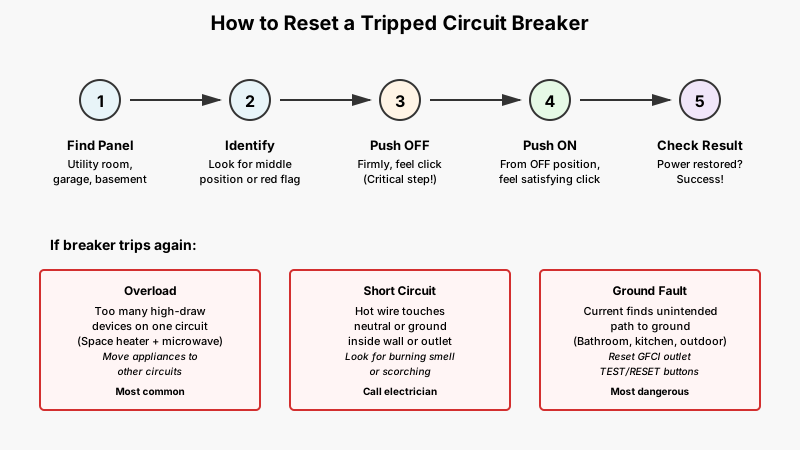
Step 1: Find Your Electrical Panel
The main panel is usually in a utility room, garage, hallway, or basement. In older homes it may be outside or in a dedicated closet. Open the door and look for a breaker whose toggle sits visibly between ON and OFF, or one that has shifted toward OFF while everything around it stayed ON.
Step 2: Identify the Tripped Breaker
Most modern breakers show a red or orange indicator window when tripped — a small flag that pops into view. If your panel has no color indicator, run your finger along the row of breakers: the tripped one will feel slightly loose or canted compared to its neighbors. Label it if it isn’t already marked; unlabeled panels cause real problems during emergencies.
Step 3: Switch It Fully OFF First
Do not just push the tripped breaker toward ON. You must first push it firmly all the way to OFF — you’ll feel it click — before switching it back to ON. Skipping the OFF step is the most common reset mistake. The internal latch won’t re-engage correctly without that full reset motion.
Step 4: Switch It Back to ON
Push the breaker firmly from OFF to ON. A satisfying click means the latch has set. If power restores to the circuit, you’re done — but keep reading to understand what caused the trip so it doesn’t happen again.
Step 5: If It Won’t Stay On
If the breaker trips immediately on reset, or it won’t latch at all, stop. Repeated tripping signals one of three things:
- Persistent overload — too many devices still drawing current on that circuit.
- Short circuit — bare wires touching inside an outlet, fixture, or appliance.
- Faulty breaker — the breaker itself has degraded and trips at loads it should handle.
A breaker that trips three times in a row without a clear cause is not a DIY problem. Call a licensed electrician.
Why Breakers Trip: The Three Main Causes
Knowing the cause tells you whether resetting is the whole solution or just the first step.
If breaker trips are a recurring issue tied to heavy appliance use, our guide How to Make Your Home More Energy Efficient: Seal, Insulate, Save offers practical ways to reduce the electrical load in your home.
Circuit Overload
This is by far the most common cause. A standard 15-amp household circuit can sustain roughly 1,440 watts (80% of 1,800W rated capacity — the NEC’s continuous-load rule). Plug a 1,500-watt space heater and a 1,200-watt microwave into outlets sharing that circuit, and it will trip, reliably. The fix is redistributing the load: move appliances to other circuits, or have an electrician add a dedicated circuit for high-draw devices.
Short Circuit
A short happens when a hot (black) wire touches a neutral (white) or ground wire directly, either inside a wall, at an outlet, or inside an appliance. Short circuits create a sudden spike of current that trips the breaker almost instantly. They’re more serious than overloads because the fault is structural, not behavioral. A burning smell at the outlet or visible scorching are reliable warning signs.
Ground Fault
A ground fault is a specific kind of short where current escapes the intended path and finds an unintended route to ground — often through a person. Bathrooms, kitchens, garages, and outdoor circuits use GFCI (ground fault circuit interrupter) outlets or breakers specifically for this reason. If a GFCI outlet tripped rather than the breaker itself, reset the outlet (its own TEST/RESET buttons) before going to the panel.

Special Cases Worth Knowing
When the Whole House Loses Power
If your main breaker — the large double-pole breaker at the top of the panel — has tripped, all circuits go dark at once. Reset it the same way: OFF, then ON. But a main breaker that trips spontaneously, with no obvious overload, warrants an inspection. Main breakers can fail, and the fault may be upstream with the utility.
Tandem and Double-Pole Breakers
Double-pole breakers (240V circuits, used for dryers, EV chargers, HVAC equipment) have two switches joined by a bar. Both sides must be in the same position. To reset, push both to OFF together, then both to ON. A tandem breaker packs two independent 120V circuits into one slot; each side resets independently.
Arc Fault Circuit Interrupters (AFCIs)
AFCI breakers have a TEST button on their face and trip in response to dangerous arcing — not just overloads. They’re required by current electrical codes in bedrooms and many living spaces. After resetting an AFCI breaker (OFF, then ON), also press its TEST button to confirm it responds correctly, then reset again. An AFCI that keeps tripping for no apparent reason can indicate loose wiring in the circuit — worth investigating before dismissing it.
Older Fuse Panels
In homes built before roughly the 1960s, you may have a fuse box rather than a breaker panel. A blown fuse must be replaced, not reset — the fusible link inside is physically melted. Turn off the main, identify the blown fuse (the element will look cloudy or blackened), and replace it with a fuse of the exact same amperage. Never install a higher-rated fuse to stop nuisance blowing; that removes the protection the fuse is there to provide.
When to Call an Electrician
Resetting a breaker is genuinely simple. Knowing when not to reset is more important.
Contact a licensed electrician if:
- The breaker trips again within a few minutes of a successful reset, with minimal load.
- You smell burning plastic or notice discoloration around outlets or the panel.
- The breaker feels hot to the touch.
- Any circuit hasn’t been touched in years and suddenly starts tripping — wiring insulation degrades over decades.
- Your panel is a recalled brand (certain Zinsco and Federal Pacific Stab-Lok panels have documented failure rates and are worth evaluating by an electrician regardless of whether they’re currently tripping).
Electrical panels don’t give many second chances. When the evidence points beyond a simple overload, trust it.

If you’re dealing with unfamiliar wiring or an electrical panel in a house you just moved into, How to Make Moving to a New Home Less Stressful: Start Early, Stay Calm can help you settle in without adding extra stress to the process.
Frequently Asked Questions
Why does my breaker keep tripping even after I reset it?
The circuit is either still overloaded (too many devices drawing current), has a wiring fault such as a short circuit, or the breaker itself has worn out. Reduce the load first. If tripping continues with minimal load, the fault is in the wiring or the breaker and needs professional diagnosis.
Is it safe to reset a tripped breaker yourself?
Yes, for a standard residential breaker under normal conditions — the procedure doesn’t expose live parts. But if you smell burning, see scorch marks, or the breaker won’t stay on, stop and call an electrician.
How do I know which breaker controls which room?
A quick method: plug a lamp into an outlet in the room you’re testing, then flip breakers one at a time until the lamp goes out. Write the room name on the panel’s directory card as you go. A circuit tracer tool does the same job without walking back and forth.
Can a breaker wear out over time?
Yes. Breakers are rated for a finite number of operations, and heat cycling gradually degrades the trip mechanism. A breaker that’s been tripping frequently for years may begin tripping at loads it used to handle without issue — a sign it’s time for replacement.
What’s the difference between a tripped breaker and a tripped GFCI outlet?
A GFCI outlet has its own built-in protection and its own RESET button. It protects that outlet and sometimes downstream outlets on the same circuit, without involving the panel breaker. Check the GFCI outlet first — pressing its RESET button may restore power without any trip to the panel at all.
Sources
- https://www.cpsc.gov/Safety-Education/Safety-Education-Centers/Electrical-Safety
- https://www.esfi.org/fuse-and-breaker-breakdown/ — ESFI, Fuse and Breaker Breakdown
- https://www.esfi.org/understanding-your-home-electrical-system/ — ESFI, Understanding Your Home Electrical System
- https://www.cpsc.gov/s3fs-public/513.pdf — CPSC, Home Electrical Safety Checklist