Minimalism for Beginners: Start Small, Change Everything

Why Minimalism Isn’t What You Think It Is
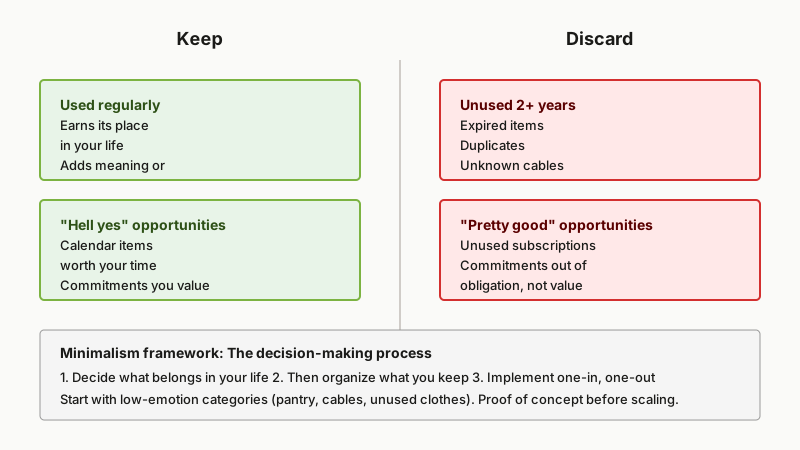
Most people picture minimalism as bare white rooms, a single chair, and three books. That image — however photogenic on Instagram — has almost nothing to do with why millions of people are drawn to simpler living. Minimalism is not an aesthetic. It’s a decision-making framework: keep what earns its place in your life, let go of the rest.
If you’re new to this, the good news is that you don’t need to own fewer than 100 things or sleep on a mat. You need to start asking a different question about your stuff, your commitments, and your time.

The Real Cost of Too Much Stuff
Clutter isn’t a neutral inconvenience. A 2011 study published in The Journal of Neuroscience found that multiple stimuli in the visual field compete for neural representation, meaning physical clutter actively reduces your brain’s ability to focus. More practically: when you have too many choices, decisions become exhausting. Psychologist Barry Schwartz coined this “the paradox of choice” — the idea that more options, past a point, increases anxiety rather than freedom.
Consider the time cost alone. The average American household contains roughly 300,000 items, according to a study by the Los Angeles–based Center on Everyday Lives of Families. Organizing, cleaning, moving, and finding those items consumes real hours every week — hours you’re probably not tracking.
Beginners often underestimate this. Minimalism isn’t about deprivation. It’s about getting rid of the friction that accumulates when you own more than you can manage.
Where to Actually Begin (Without Burning Your Life Down)
Start with the easy wins
Don’t begin in your childhood bedroom or the attic. Both are emotional minefields for a first-timer. Instead, pick a single category with low emotional weight:
- Expired pantry items and duplicate kitchen tools. Most kitchens have three spatulas and a mandoline slicer used once in 2019.
- Old cables and chargers you can’t identify. If you don’t know what it charges, it’s safe to go.
- Clothes you’ve owned for over two years but haven’t worn. Be honest. Not “I’ll wear it on a special occasion” honest. Actually honest.
The goal of this first pass is not transformation — it’s proof of concept. You want to feel the concrete lightness that comes from a cleared-out drawer before you tackle the garage.
For a related project that trims down what comes into your home in the first place, check out Easy Ways to Reduce Plastic at Home: 30 Practical Swaps.
Use the one-in, one-out rule
Before you even declutter, implement this habit: every time you bring something new into your home, something else leaves. New pair of shoes means an old pair goes to donation. New book means one gets passed on. This single habit stops the inflow from rebuilding the clutter you’ve cleared. It also forces you to pause before buying, because now every purchase has a cost beyond money.
Don’t organize, decide
Organizing is the most common mistake beginners make. Buying storage bins, drawer dividers, and shelf systems feels productive, but it’s often just rearranging the problem. Professional organizer Marie Kondo built a global brand around one sharp idea: before you figure out where to put something, decide whether it belongs in your life at all.
That sequence matters. Decide first, organize second.

Minimalism Beyond Physical Stuff
If you’re working on shifting your mindset toward what truly matters, How to Start a Gratitude Practice (and Actually Stick With It) pairs surprisingly well with a decluttered life.
Time and commitments
Once you declutter your space, you’ll notice the same dynamic applies to your schedule. Calendar clutter is just as real. Commitments that seemed worth saying yes to — a committee, a standing dinner with an acquaintance you don’t particularly like, a subscription service you barely use — add up to a week that feels full but not meaningful.
Gregory McKeown’s book Essentialism (2014) makes a useful distinction: the difference between “pretty good” opportunities and the “hell yes” opportunities worth your time. Applying this lens to your calendar is minimalism applied to time.
Start with subscriptions. List every recurring charge in your bank or credit card statements. Cancel anything you haven’t actively used in 60 days. The average American pays for 4.5 streaming services; many people have gym memberships they haven’t used since January. This one pass typically frees both money and mental space.
If you’re also trying to reclaim mental space from your schedule, building a sustainable system like the one in Read More Books Each Month: Build A System, Not Willpower can be a great way to fill the time you free up with something nourishing instead of another obligation.
Digital clutter
Your phone is a clutter problem too. The average person has 80+ apps installed but regularly uses fewer than 10. Notifications from apps you rarely open fragment your attention dozens of times per day.
A practical approach:
- Delete every app you haven’t opened in 30 days.
- Turn off all non-essential notifications — be ruthless. Allow notifications only from direct human communication (calls, messages) and anything safety-critical.
- Move your phone’s home screen to contain only tools you use intentionally. Social media apps off the home screen — or deleted entirely — reduces mindless checking by a surprising margin.
Your email inbox is a separate problem. Zero inbox is a real system, not a fantasy, but it starts with unsubscribing: one tool, Unroll.me, lets you see all your subscriptions in one view and mass-unsubscribe. Run it once and the daily volume drops noticeably.
Relationships and social obligations
This is the most sensitive territory. Minimalism applied to relationships doesn’t mean becoming a hermit or cutting off everyone who isn’t perfect. It means being intentional about where you invest relational energy. Not every friendship needs to be maintained at the same intensity. Accepting that some relationships have naturally run their course — rather than maintaining them out of obligation — is genuinely freeing and honest.
The Psychology of Letting Go
People hold onto things for three main reasons: sunk cost (“I paid a lot for this”), identity (“this is who I used to be or hoped to be”), and anxiety about future need (“I might need this someday”).
The sunk cost is already gone regardless of what you do with the object. Keeping a guitar you never play doesn’t recover the $400 you spent. Selling it for $80 and clearing the closet at least recovers something.
Identity items are trickier. The ski equipment from a phase you’ve left behind, the professional wardrobe from a job you no longer have — these items carry a quiet guilt because they represent a version of yourself you feel you should return to. Letting them go is permission to live in the present version.
The “someday” anxiety is best addressed statistically. If you haven’t needed it in two years and it costs less than $20 to replace, let it go. The category of items you’ll regret getting rid of is genuinely small.

Practical Timelines: What to Expect
Minimalism isn’t a project you complete in a weekend. Most people move through it in stages:
Month 1: Quick wins — surfaces, expired items, obvious duplicates. The house probably looks 20% better. You feel the motivation to continue.
Months 2–3: Clothing, books, sentimental items. This is where real decisions happen and where some people stall. That’s normal. Go at a pace that doesn’t feel punishing.
Months 4–6: Lifestyle habits — subscriptions, commitments, digital habits — get examined. The material phase winds down and the behavioral phase begins.
Ongoing: Maintenance. The one-in, one-out rule. Annual reviews of what’s crept back in. This never becomes entirely passive, but it does become easier.
Expect some setbacks. A stressful month often triggers buying as comfort — retail therapy is real. Notice the pattern without self-judgment and reset.
Common Pitfalls for Beginners
Buying minimalist. This is a recognized irony in the community. People declutter and then buy expensive, aesthetically minimal replacements. Watch for this. The point isn’t to own nicer things — it’s to own fewer.
Imposing it on others. Your minimalist journey doesn’t give you the right to throw out your partner’s things or lecture a housemate. Work on your own spaces, and let the results speak. If you live with others, negotiate shared spaces with actual conversation.
Treating it as an identity. Once minimalism becomes a badge, you start making decisions to perform minimalism rather than to actually improve your life. Use the framework; don’t become the framework.
Getting Started Today: Three Concrete Steps
- Set a timer for 15 minutes and walk through one room. Collect everything that’s broken, expired, or hasn’t been touched in a year. Put it in a bag. Drop it off this week.
- Pull up your bank or credit card statement and cancel any subscription you can’t name a specific recent use for.
- Pick one surface — a desk, a kitchen counter, a bedside table — and commit to keeping it clear for 30 days. Just one surface. The habit of a clear space trains your eye to notice what belongs and what doesn’t.
That’s it for day one. None of these steps require commitment to an aesthetic or a philosophy. They just require fifteen minutes and a little honesty.
Conclusion
Minimalism done well isn’t about having less for its own sake. It’s about having less of what you don’t need so you have more room — physically, mentally, financially — for what you actually do. The people who stick with it aren’t the ones who read the most books on the subject. They’re the ones who started with one drawer and felt the difference.
Start there.
Frequently Asked Questions
Is minimalism only practical for people who live alone?
Minimalism can absolutely work in shared households, but it requires negotiation rather than unilateral decisions. A useful approach is to focus exclusively on your own belongings and any shared spaces both parties agree to address together, leaving each person’s private areas entirely under their own control.
What should I do with items I declutter — donate, sell, or throw away?
The priority order most people find worthwhile is: donate or gift first for items in good condition, sell only if the item has meaningful resale value and you’ll actually follow through quickly, and discard as a last resort. Letting a bag of donations sit in your car for weeks defeats the purpose, so picking a specific drop-off date matters more than optimizing for the best outlet.
Can minimalism save a significant amount of money, or is that overstated?
The savings come from two directions: one-time recovery through selling items, and the ongoing effect of buying less impulsively once you’re in the habit of questioning each purchase. The subscription audit alone tends to produce immediate, recurring savings that many people find genuinely surprising when they add up the monthly total.
How do I handle sentimental items I feel guilty about keeping but can’t bring myself to discard?
A common and practical middle path is consolidating sentimental items into a single clearly defined container — one box, one shelf — rather than letting them scatter throughout the home. This acknowledges their emotional weight without allowing them to expand indefinitely, and it makes future reviews easier because everything is in one place.