How to Make a Roux for Sauces: Fixing Broken Gravies And Gluey Sauces

A roux is one of the most useful things you can learn in a kitchen — two ingredients, a few minutes of attention, and you unlock thickening power that underpins dozens of classical and everyday sauces. If béchamel has ever broken on you, or a gravy came out gluey instead of silky, the roux was probably the culprit. This guide walks through the technique from the pan to the finished sauce, including the common mistakes that derail home cooks.
What Is a Roux, Exactly?
A roux is a cooked mixture of equal parts fat and flour by weight. That’s the whole definition. The fat can be butter, lard, oil, or even bacon drippings; the flour is almost always plain all-purpose (or plain white flour outside North America). The cooking process does two things: it disperses the starch granules in fat so they won’t clump when liquid hits them, and it drives off the raw flour taste. How long you cook it determines the color and, with it, the flavor and thickening strength.
The ratio that matters most is 1:1 fat to flour by weight — not by volume. A tablespoon of butter weighs around 14 g; a tablespoon of sifted flour weighs around 8–9 g. If you measure by volume you’ll usually end up with more flour than fat, which produces a paste that tastes chalky. A kitchen scale removes the guesswork entirely.
Fat Choices and Their Effects
- Clarified butter or whole butter — the classic choice for French mother sauces. Whole butter adds a slight nutty sweetness as it cooks; clarified butter (ghee) gives you a purer, cleaner roux that’s easier to control.
- Neutral oil (sunflower, canola) — good for dairy-free sauces and for dark Cajun-style roux, since oil won’t burn as quickly as butter at high heat.
- Lard or schmaltz — traditional in certain European and Southern cooking; adds a richer, more savory baseline flavor.
- Pan drippings — when making pan gravy, using the drippings directly is both practical and deeply flavorful.

The Four Types of Roux
Color is a shorthand for doneness. Each stage has a different application:
White Roux
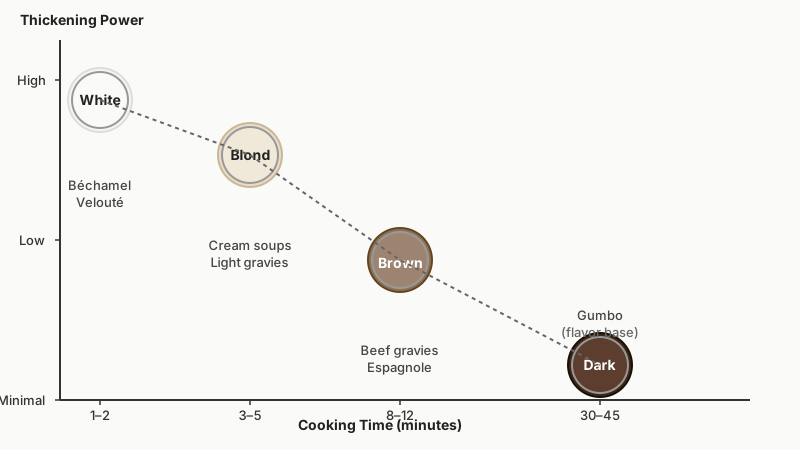
Cooked for just 1–2 minutes after the flour is added, until it smells like cooked pastry but has no color change. This is what you want for béchamel (the base of mac and cheese, lasagne sauce, and croque monsieur) and velouté. It has the strongest thickening power of the four types because the starch structure is minimally broken down.
Blond Roux
Cooked 3–5 minutes, stirring constantly, until the mixture turns the color of pale sand and smells faintly nutty. The go-to for cream-based soups, chicken velouté, and lighter gravies. Slightly less thickening power than white, but better flavor.
Brown Roux
Cooked 8–12 minutes over medium heat until it looks like milk chocolate and has a pronounced nutty, toasty aroma. Used in espagnole (brown sauce), beef gravies, and gumbo in its lighter form. Noticeably less thickening power — you’ll need more of it by weight compared to white roux to reach the same consistency.
Dark (Brick or Chocolate) Roux
The hallmark of Louisiana cooking — particularly gumbo. This takes 30–45 minutes of near-constant stirring over medium-low heat. The color goes from brown to a deep reddish-brick or near-black. At this point almost all thickening power is gone; the roux functions as a flavor base, not a thickener. Gumbo gets its body instead from okra or filé powder.
A practical rule: the darker the roux, the more you’ll need and the longer it will take to thicken your sauce.
Step-by-Step: How to Make a Basic Roux
The method below works for any ratio from a small single-serve sauce to a large batch.
You’ll need:
- Equal weights of fat and flour (start with 30 g each for about 500 ml of finished sauce)
- A heavy-bottomed saucepan or skillet (cast iron or stainless steel — avoid nonstick for high-heat dark roux)
- A wooden spoon or flat-edged wooden spatula
Step 1 — Melt the fat. Over medium heat, melt the butter (or warm the oil) until it’s fully liquid and just starting to foam slightly. Do not let it brown.
Step 2 — Add the flour all at once. Tip in all the flour in one go and stir immediately. Within seconds it will combine into a thick, smooth paste.
Step 3 — Cook it, stirring constantly. Keep scraping the bottom and edges. For a white roux, you’re done in 1–2 minutes. For a blond roux, give it 3–5 minutes. Use your nose as much as your eyes — the raw flour smell disappears before visible color change.
Step 4 — Add your liquid gradually. This is where most sauces go wrong. Pull the pan off the heat, add a small splash of warm liquid (stock, milk, cream), and stir vigorously until it’s fully absorbed. Return to heat and add the rest in a slow, steady stream, whisking constantly. Cold liquid into a hot roux or hot liquid into a cold roux both work — the key is adding slowly and whisking hard.
Step 5 — Simmer to finish. Once all the liquid is incorporated, bring the sauce to a gentle simmer for at least 5 minutes. This finishes cooking out any residual starch taste and lets the sauce reach its final consistency. It will thicken noticeably as it simmers.

Ratios for Common Sauces
The amount of roux you need depends on how thick you want the sauce to be. These are reliable starting points based on classical French ratios:
| Sauce thickness | Roux (butter + flour each) per 500 ml liquid |
|---|---|
| Light (soup consistency) | 15 g + 15 g |
| Medium (coating sauce) | 30 g + 30 g |
| Thick (soufflé base, croquette filling) | 45 g + 45 g |
Remember: a darker roux needs roughly double the quantity of a white roux to achieve the same thickening effect, because the starches have been partially broken down by heat.
Common Mistakes and How to Fix Them
Lumpy sauce. Almost always caused by adding liquid too fast, or by flour that wasn’t fully dispersed in the fat before liquid was added. Fix: strain the sauce through a fine-mesh sieve and whisk again. Prevention: add liquid in stages, whisking hard each time.
Raw flour taste. You didn’t cook the roux long enough, or you didn’t simmer the finished sauce for at least 5 minutes. Simmer it longer — the taste does cook out.
Sauce won’t thicken. Either the ratio was off (too little roux for the volume of liquid), or you’re comparing before and after: sauce thickens significantly as it cools. Give it time on the heat, then test again. If it’s still thin after 10 minutes of simmering, make a small additional roux separately and whisk it in.
Sauce is too thick. Add a little more warm liquid — stock, milk, or even water — and whisk over low heat.
Burned or bitter roux. There’s no saving a burned roux. Discard it and start again. Prevent it by keeping the heat medium-low, especially as you approach the blond stage, and never stopping your stirring.
Greasy sauce. Too much fat relative to flour, or fat that separated back out during simmering. A light simmer with occasional stirring usually reintegrates it. If the sauce is very greasy, skim the surface.
Gluey textures aren’t unique to roux, either, as our piece How to Cook Quinoa Properly: Why Your Pot Turns Gluey explains a similar starch problem in another kitchen staple.
Making and Storing Roux in Advance
Roux keeps extremely well. You can make a large batch, pour it into a container, and refrigerate it for up to a month, or freeze it for three months. Many professional kitchens do exactly this. To use: scoop out a knob of cold roux, add it directly to your hot simmering liquid, and whisk — it melts in and thickens the sauce without any lumping. This is actually one of the cleanest ways to thicken a sauce on the fly.
For dark gumbo roux specifically, making it in advance not only saves time on the day but improves flavor — the roux mellows and deepens overnight in the fridge.

Beyond the Basics: Variations Worth Knowing
Beurre manié is the lazy cousin of roux — raw butter kneaded with flour, rolled into small balls, and whisked into a simmering sauce at the end. It thickens without pre-cooking and is useful for quick fixes, though the sauce needs to simmer for a few minutes to cook out the flour taste.
Gluten-free roux works using white rice flour or a 1:1 gluten-free baking blend in place of all-purpose flour. The method is identical; the result is slightly less silky but perfectly functional for béchamel and gravies.
Whole wheat or spelt flour can replace all-purpose for a nuttier, slightly denser roux. It’s well-suited to dark brown sauces and gravies where the wheaty flavor isn’t out of place.
If you want to explore other classic ways to thicken and enrich sauces, Homemade Mayonnaise & Emulsified Sauces From Scratch covers the technique of emulsifying oil and egg into a stable sauce.
Conclusion
Making a good roux isn’t difficult — it just requires paying attention to heat, ratio, and the speed at which you add liquid. Get those three things right and you have a foundation for béchamel, velouté, espagnole, country gravy, gumbo, and a dozen other dishes. The technique doesn’t change much whether you’re making a two-portion mac and cheese or a pot of gumbo for twenty people; only the quantities scale.
If you take one thing away: weigh your fat and flour rather than measuring by volume, cook the roux long enough to eliminate the raw taste, and add your liquid slowly. Everything else is just practice.