Fold Clothes to Save Closet Space: File, Don't Stack Garments

If your closet feels smaller than it actually is, the culprit is almost always the same thing: clothes that aren’t folded efficiently. Bulky stacks collapse, thin shelves overflow, and before long you’re shoving T-shirts in anywhere they’ll fit. The good news is that changing how you fold — not necessarily buying more storage — solves most of the problem.
This guide covers the most effective folding methods, organized by garment type, along with a few honest notes about where each technique actually works versus where it’s overhyped.
Why Folding Style Matters More Than You Think
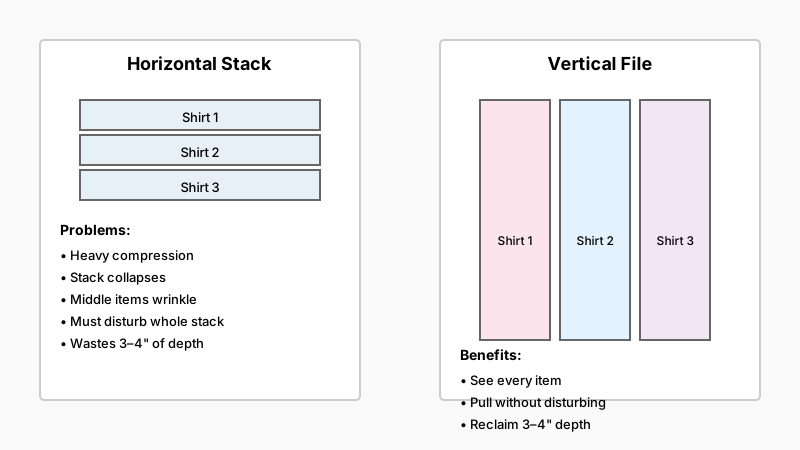
Most people fold clothes the way they were taught as kids — stack horizontally, pile on top. The problem with horizontal stacking is physics: the more you add, the heavier the pile, the more likely it tips over or gets compressed into a wrinkled mass. Retrieving something from the middle means destroying the whole stack.
Vertical filing changes that completely. When clothes stand upright in a drawer like files in a cabinet, you can see everything at a glance, pull one item without disturbing the rest, and fit significantly more per shelf or drawer. Studies on household organization consistently show that vertical storage reduces retrieval time and increases how much clothing a person can store in a given space — the KonMari method popularized this arrangement, though the underlying principle predates it.
The second factor is folded volume. Some folds trap more air than others. A T-shirt folded in thirds and then rolled takes up roughly half the space of a T-shirt folded flat and stacked. Compression is real, and technique drives it.

Folding Methods by Garment Type
T-Shirts and Casual Tops
The File Fold (Vertical Method)
This is the most space-efficient approach for drawers.
- Lay the shirt face-down on a flat surface.
- Fold one side (about one-third) toward the center, folding the sleeve back so it stays within the body’s outline.
- Repeat on the other side.
- Fold the bottom hem up to the collar — or in two steps if the shirt is long.
- Stand the resulting rectangle upright in the drawer.
The finished shirt should look like a neat brick that stands on its own. Once you file 10–15 shirts this way, you’ll typically reclaim three to four inches of drawer depth versus horizontal stacking.
The Ranger Roll
Originally used by military personnel to pack efficiently in a bag, the ranger roll produces an even tighter result.
- Lay the shirt face-up and fold the bottom hem up about three inches (creating a cuff).
- Fold the sides in, then roll tightly from the collar end down.
- Tuck the roll into the cuff to lock it.
Ranger rolls are ideal for travel or for shelf bins where you want a compact, self-contained bundle. They’re less suited to permanent drawer organization because unrolling and re-rolling daily gets tiresome.
Once you’ve mastered filing shirts at home, How to Pack a Suitcase Efficiently: Roll, Fold, and Skip Overpacking shows how the same folding logic keeps a suitcase compact and wrinkle-free.
Jeans and Trousers
Denim is bulky and resists compression, so the goal is eliminating dead air.
- Lay trousers flat, fold one leg over the other so they align.
- Fold lengthwise in half (so the crotch seam is inside).
- Fold the waist down to the hem in thirds rather than halves — thirds create a shorter, more stable rectangle.
- File vertically in a drawer, or stand on a shelf.
For trousers you want crease-free, hanging is almost always better than folding. Reserve folding for denim and casual pants.
Sweaters and Knitwear
Knitwear should almost never be hung — hangers distort the shoulders over time. Folding and shelving is correct, but bulk is a challenge.
- Lay the sweater face-down.
- Fold both arms across the back so they form an X.
- Fold the body in thirds vertically.
- Fold from the bottom up until you have a compact square.
Heavier knits won’t file vertically as well as lighter fabrics, so shelving in a flat stack (limited to five or six items) is acceptable. Use shelf dividers — inexpensive plastic or metal clips that attach to the shelf edge — to prevent stacks from toppling.

Underwear and Socks
Small items eat drawer space through sheer disorder. Two techniques work well:
Underwear: Fold each pair into a thirds-and-fold packet — fold one side to the center, fold the other side over it, then fold the waistband down to create a compact square. File upright.
Socks: Avoid the ball-and-turn method (it stretches the elastic). Instead, lay one sock on top of the other, fold in half, then fold in half again. File the resulting rectangle upright. A standard men’s sock pair folded this way is roughly the size of a deck of cards — you can fit 20+ pairs in a single drawer tier.
Button-Down Shirts
Button-downs crease more than knits, so folding works best for casual versions (chambray, flannel) rather than dress shirts, which should stay on hangers.
- Button every other button so the shirt holds its shape.
- Lay face-down, fold one side inward with the sleeve flat behind it.
- Repeat on the other side.
- Fold the collar end down, then fold the hem end up to meet it.
- File vertically.
Bed Linens
Sheets and pillowcases are closet-space killers when stored loosely. The trick used in hotels is the “pillowcase bundle”:
- Fold the flat sheet and fitted sheet as neatly as possible into rectangles.
- Tuck both inside one of the matching pillowcases.
- Store the bundle on a shelf — it’s self-contained and immediately identifiable by color.
Duvet covers can be folded into thirds lengthwise, then rolled — the roll fits neatly on a shelf without collapsing.
Maximizing Shelf and Drawer Space Beyond the Fold
Even perfect folding only goes so far if your closet’s physical setup works against you. A few adjustments that compound the gains:
Shelf dividers — As mentioned for knitwear, these prevent stacks from leaning and merging. They’re under $15 for a set and available at any home goods store.
Drawer organizers — Fabric or bamboo inserts section off large drawers so small items (socks, underwear, accessories) don’t migrate into each other’s territory. Without them, even well-folded items shift within a week.
Adjustable shelving — Many closets ship with shelves set at default heights designed for no one in particular. If yours are adjustable, measure your most common folded stacks and set shelf heights to match, leaving an inch of clearance. You can often add an entire extra shelf where there was wasted vertical space.
Seasonal rotation — Items you wear only in summer or only in winter take up prime closet real estate year-round. Store off-season clothes in flat under-bed containers or vacuum compression bags on high shelves. This alone often frees 20–30% of accessible closet space.
Category clustering — Group by type, then by color within each type. When everything has a defined zone, there’s no temptation to dump something wherever it fits, which is what unravels an organized closet within days.

If your drawers are the last piece of a bigger space puzzle, How to Organize a Small Closet: Purge First, Then Map The Space walks you through purging and mapping the whole closet before you tackle the folds inside it.
Common Folding Mistakes to Avoid
Folding damp clothes. Even slightly damp fabric creates musty smells and mildew over time. Always fold dry.
Over-filling drawers. Vertical filing only works when there’s enough room for clothes to stand. If you have to shove the drawer shut, remove a few items — they can go on a hanger or a different shelf.
Inconsistent fold size. If you fold T-shirts to different widths on different days, they won’t stand reliably. Pick one target width (usually a third of the shirt’s body width) and stick to it.
Ignoring fabric behavior. Silk and delicate fabrics wrinkle when filed tightly. These belong on hangers or folded with tissue paper on a flat shelf, not shoved upright in a drawer with cotton tees.
Folding everything. Some clothes genuinely do better on hangers — structured blazers, dress shirts, any item with lining. Forcing those into drawers to “save space” creates more problems than it solves.
Building a Habit That Sticks
The biggest challenge with efficient folding isn’t the technique — it’s consistency. A few habits make it easier to maintain:
- Fold directly from the laundry basket, not from a pile on the bed. Once clothes hit the bed, the temptation to “sort it later” is almost irresistible.
- Give every item a home before folding it. If a piece doesn’t have a designated drawer or shelf spot, it will end up somewhere random.
- Do a quick reset once a week. Spend five minutes straightening drawers and standing up any tipped files. This prevents small disorder from compounding.
- Declutter before organizing. No folding method compensates for owning more than the space can hold. If a closet is chronically overcrowded, removing items is the only durable fix.
Conclusion
Saving closet space through folding comes down to two principles: vertical filing to see and access everything without disturbing the stack, and compact folding to reduce the air trapped in each garment. Apply the file fold to T-shirts and casual tops, the thirds method to denim, and the pillowcase bundle trick to linens — and most closets will reveal space you didn’t know was there.
You don’t need to buy a system. You need a technique, a bit of consistency, and a willingness to rethink a habit you probably formed in childhood. Start with one drawer. Fold everything in it vertically. Chances are you’ll be reorganizing the rest of the closet the same afternoon.