Best Nonstick Pans That Actually Last: A Buyer's Guide

Most nonstick pans start life feeling miraculous — eggs glide, sauces wipe clean — and then, somewhere between month six and year two, the coating starts to chip, scratch, or simply stop releasing food the way it once did. The frustrating part isn’t that nonstick pans wear out; it’s that some wear out in months while others hold up for years under nearly identical use. The difference usually comes down to coating type, base metal quality, and a handful of construction details that most marketing copy glosses over.
This guide focuses on pans that are genuinely built to last: what makes them durable, which specific models earn long-term trust, and how to use and care for whichever one you choose so the coating actually reaches its potential lifespan.
Why Most Nonstick Pans Fail Early
Understanding the failure modes tells you exactly what to look for when shopping.
Heat damage is the biggest killer. Traditional PTFE (the coating most people call “Teflon”) begins to degrade meaningfully above around 500°F (260°C). An empty pan on a medium-high burner can exceed that in minutes. Most cheap pans use a single- or double-layer PTFE coat over thin aluminum; once the coating thins, hot spots accelerate the damage. Higher-end pans use three to five reinforced layers — often with ceramic or titanium particles bonded into the PTFE — which dramatically extends the window before the surface fails.
Metal utensils are a secondary killer, not the primary one. A dense, well-bonded multi-layer coating can survive the occasional metal spatula. A thin one can’t. The coating’s thickness and bond quality matter far more than whether you occasionally use a metal spoon.
Dishwasher cycling degrades coatings faster than most manufacturers admit. The harsh detergents and high-heat drying cycles strip the surface layers over time. Even pans marketed as “dishwasher safe” typically outlast their coating considerably longer when hand-washed.
Thin bases warp. A warped pan rocks on the burner, creating uneven heat and hot spots that burn both food and coating. A heavier base — at least 4–5 mm of aluminum, ideally with a stainless or hard-anodized exterior — resists warping far better.

The Coating Types That Hold Up Best
Not all nonstick surfaces are created equal, and the category has evolved considerably beyond simple PTFE.
Reinforced PTFE (Multi-Layer)
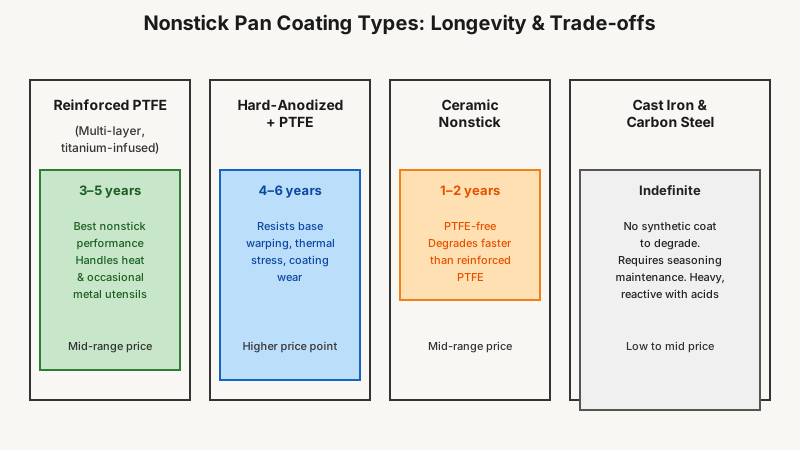
This remains the gold standard for actual nonstick performance. Look for coatings branded as Toughened Nonstick, Titanium-Infused PTFE, or similar — they embed hard particles into the polymer matrix to resist abrasion. Brands like Tefal (T-fal), Calphalon, and All-Clad use versions of this approach. A three-layer minimum is worth insisting on; five layers is better if your budget allows.
Hard-Anodized Aluminum Base with PTFE
Hard-anodized aluminum is electrochemically hardened to be roughly twice as hard as stainless steel. Pairing that base with a reinforced PTFE coating gives you a pan that handles thermal stress well and resists the base warping that accelerates coating wear. Calphalon’s hard-anodized lines and OXO’s Obsidian series use this construction.
Ceramic Nonstick
Ceramic coatings (sol-gel based, not actual ceramic) are PTFE-free and gained popularity partly on safety concerns — though PTFE-coated cookware at normal cooking temperatures is considered safe by food-safety authorities. The honest trade-off: ceramic coatings typically degrade faster than well-made PTFE, losing their release properties within one to two years of regular use for most people. They’re a reasonable choice if you specifically want PTFE-free, but don’t expect the same longevity. GreenPan and Caraway make the most consistently reviewed ceramic options.
Cast Iron and Carbon Steel (Seasoned)
These aren’t nonstick pans in the conventional sense, but a well-seasoned cast iron or carbon steel pan approaches genuine nonstick for eggs and fish without any synthetic coating to degrade. The trade-off is weight, the learning curve of seasoning, and reactivity with acidic foods. For someone willing to maintain them, they’re the only truly indefinite option.
The Pans Worth Buying
The following recommendations are based on construction quality, consistent long-term user feedback, and the durability principles above. Prices shift, so treat these as benchmarks rather than fixed figures.
Tefal Unlimited (All-in-One Series)
Tefal’s Titanium Expertise coating — five reinforced layers over a hard-anodized base — is among the densest PTFE constructions available at a mid-range price. The signature Thermo-Spot heat indicator (a red dot that appears when the pan is at optimal cooking temperature) also prevents the overheating that kills coatings. It works on all hob types including induction. Consistent user feedback over extended periods puts this among the better performers under everyday household use.
All-Clad HA1 Hard Anodized
All-Clad is better known for its stainless steel bonded cookware, but the HA1 line applies the same build standards to nonstick. The hard-anodized exterior is notably thick, the three-layer PTFE interior is PFOA-free, and the riveted stainless handle adds structural rigidity. It’s oven-safe to 500°F and built to a standard that’s meant to last. The price is higher than average, but the gap narrows considerably if you factor in replacement cycles.
Calphalon Premier Space-Saving
Calphalon’s Premier line uses a three-layer nonstick interior over hard-anodized aluminum, with flat-stacking lids — a practical feature. What earns it a place here is the base thickness: it’s heavy enough to resist warping and distributes heat evenly, which limits hot spots. It handles the oven to 400°F. Lifetime warranty coverage from Calphalon adds some purchase confidence.
OXO Good Grips Obsidian
This is a relatively newer entry in the hard-anodized category but has attracted strong feedback for build quality at a mid-range price. The Obsidian line uses a German-engineered PTFE coating over a thick anodized base, with a flared edge for pouring and a stay-cool handle. It’s dishwasher-safe according to OXO, though hand-washing will extend its life considerably.
GreenPan Valencia Pro
If ceramic is your preference, the Valencia Pro is the most consistently recommended option. The Thermolon Minerals Pro coating is reinforced with minerals and applied over a hard-anodized base — a sturdier foundation than most ceramic competitors. It’s induction-compatible and oven-safe to 600°F, which is notably higher than most PTFE options. Ceramic coatings still lose performance faster than good PTFE over time, but for PTFE-free users, this is the most durable choice in that category.

How to Make Any Nonstick Pan Last Longer
Even a well-built pan can be shortened significantly by common habits.
Stay below medium-high heat for almost everything. Nonstick coatings don’t need or benefit from high heat — the nonstick surface itself conducts heat to food very efficiently. Medium is usually enough. High heat is for searing proteins, and a nonstick pan isn’t the best tool for that anyway (use stainless or cast iron for a hard sear).
Preheat gradually. Don’t blast an empty pan on high to “warm it up.” Start on low-medium and bring it to temperature with food or fat in it.
Use fat, even on nonstick. A small amount of butter or oil isn’t just for flavor — it creates a buffer layer that prevents food from directly contacting the coating surface and helps distribute heat. Cooking completely dry accelerates wear.
Hand-wash with a soft cloth or sponge. Avoid abrasive pads and harsh detergents. Warm soapy water and a non-scratch sponge are all you need.
Don’t stack pans without protection. Stacking bare pans scratches the cooking surface of the pan underneath. A cloth, silicone pad, or paper towel between each pan is a small habit that meaningfully extends surface life.
Replace when the coating is visibly damaged. Flaking or peeling PTFE is a sign the pan has reached end of life. A worn coating that’s smooth but less slick is mostly a performance issue; visible flaking warrants replacement.
Once your pan is in good shape, pairing it with the right technique matters too, as explained in How to Cook Pasta So the Sauce Actually Clings.
Frequently Asked Questions
How long should a quality nonstick pan actually last?
With careful use — medium heat, hand-washing, soft utensils — a well-made multi-layer PTFE pan typically performs well for three to five years of regular household cooking. Ceramic coatings tend to lose their release properties sooner, often within one to two years of regular use. Cheap single-layer pans can fail in under a year.
Is PTFE (Teflon) safe to cook on?
PTFE coatings are considered safe at normal cooking temperatures. The concern, historically, was PFOA — a processing chemical used in older manufacturing — but PFOA has been phased out of cookware production in most major markets. At extreme temperatures (above roughly 500°F / 260°C), PTFE can begin to break down and release fumes that are harmful to birds and potentially irritating to humans, which is why avoiding overheating an empty pan is important.
What’s the real difference between ceramic and PTFE nonstick?
Ceramic coatings are PTFE-free and marketed as more “natural,” but they typically lose their nonstick performance faster. PTFE-based coatings, especially multi-layer reinforced versions, maintain their release properties longer. Neither is obviously “better” for health at normal cooking temperatures — the meaningful trade-off is longevity vs. a PTFE-free preference.
Can I use metal utensils on a nonstick pan?
Occasionally with a high-quality, thick multi-layer coating — probably fine. Regularly with a cheap or worn coating — it will accelerate damage. Silicone or wooden utensils are the safer default regardless of the pan’s quality. Think of it less as a hard rule and more as a risk-management decision based on the pan you actually have.
Does induction cooking wear out nonstick pans faster?
Induction heats more precisely than gas or electric resistance, which can actually be gentler on coatings since it’s easier to avoid accidental overheating. The main risk is cheap pans with thin induction-compatible discs bonded to the base — those discs can delaminate over time. A pan with a properly integrated induction-compatible base (look for fully bonded stainless-clad bottoms) doesn’t have that vulnerability.

The Bottom Line
The pans that genuinely last share a few traits: a hard-anodized or thick aluminum base that resists warping, a multi-layer reinforced coating rather than a single thin one, and a design that handles heat distribution evenly. Budget matters less than construction — a mid-range pan built to these standards will outlast an expensive pan that cuts corners on coating thickness.
Buying well once and learning the three or four habits that protect the coating is a far better strategy than replacing cheap pans every year. The math favors the quality purchase almost every time.
Now that your kitchen is equipped with a pan that won’t let you down, put it to work with 15 Easy Weeknight Dinner Recipes Ready in 30 Min.