Best Houseplants for Beginners: 12 Picks That Actually Survive

If you’ve killed a cactus and sworn off houseplants forever, you’re not alone — and you’re probably not the problem. Most plant failures come down to a mismatch between a plant’s real needs and what people think those needs are. The good news: a handful of species are genuinely hard to kill, look great, and reward minimal attention. This guide covers twelve of them, explains why they work for beginners, and gives you the honest care intel most articles gloss over.
Why Beginners Struggle (and How to Choose Differently)
The most common beginner mistake isn’t underwatering or overwatering — it’s buying a plant based on looks, then trying to force it into whatever light and space you happen to have. A fiddle-leaf fig photographed in a bright Copenhagen apartment will sulk in a dim London flat. A succulent that thrives on a south-facing windowsill will rot on a north-facing shelf.
When choosing a beginner plant, prioritize:
- Tolerance for irregular watering. Life gets busy. Plants that store water or go dormant without drama are forgiving.
- Adaptability to indoor light. Most homes have moderate to low light. Choose plants that are naturally adapted to forest floors or filtered canopies, not full tropical sun.
- Resistance to common pests. Spider mites and fungus gnats are inevitable at some point. Some species shrug them off; others collapse at the first infestation.
- Clear, simple care signals. Plants that droop visibly when thirsty (and perk back up after watering) give you useful feedback instead of silently declining.

The 12 Best Houseplants for Beginners
1. Pothos (Epipremnum aureum)
Pothos is the benchmark beginner plant for good reason. It tolerates low light, irregular watering, and almost any humidity level. The trailing vines grow fast enough to feel rewarding — sometimes several inches per week in good conditions — and they root easily in a glass of water if you want free new plants. Golden pothos has splashy yellow-green variegation; ’Marble Queen’ is more cream-toned. Both are equally easy. Water when the top two inches of soil feel dry, and ignore it otherwise.
2. Snake Plant (Dracaena trifasciata, formerly Sansevieria)
The snake plant’s party trick is surviving serious neglect. It stores water in its thick leaves, tolerates low light, and actually prefers to dry out completely between waterings. Overwatering is the one way to kill it — root rot sets in fast in soggy soil. Beyond that, it’s nearly indestructible, produces architectural upright leaves, and has been shown in NASA’s Clean Air Study to absorb certain volatile organic compounds, though the practical air-purification benefit in a real home is modest.
3. ZZ Plant (Zamioculcas zamiifolia)
If you travel frequently or tend to forget plants exist, the ZZ plant is your match. Its rhizomes store water underground, meaning it can go weeks — sometimes over a month — without watering and look completely unbothered. It grows slowly, so it won’t outgrow a spot quickly, and it tolerates fluorescent office lighting as well as any plant. One caveat: all parts are toxic if ingested, so keep it away from pets and small children.
4. Spider Plant (Chlorophytum comosum)
Spider plants are fast-growing, non-toxic to cats and dogs (a rarity among popular houseplants), and produce cascading ’babies’ — small offshoots on long runners — that you can pot up and give away. They prefer indirect light and moderate watering, and they communicate clearly: pale leaves mean too much direct sun; brown tips usually mean fluoride in tap water (switch to filtered or rainwater if it bothers you). One of the few plants that actively rewards engagement.
5. Rubber Plant (Ficus elastica)
For beginners who want something sculptural and tree-like, the rubber plant delivers. Its large, glossy leaves — deep green in the standard variety, nearly black-red in ’Burgundy’ — make a strong visual statement. It prefers bright indirect light but adjusts to moderate light reasonably well. Water when the top inch of soil is dry, wipe the leaves occasionally to keep them photosynthesizing efficiently, and it will grow steadily for years.
6. Peace Lily (Spathiphyllum spp.)
Peace lilies are one of the few flowering plants that thrive in low light, which makes them unusually useful. They communicate thirst by drooping dramatically — and then recovering just as dramatically within an hour of watering, which is enormously satisfying. They prefer consistent moisture but tolerate a missed watering. Note: they’re toxic to cats and dogs, and the sap can irritate skin, so handle with care.

7. Aloe Vera
Aloe vera sits at the intersection of practical and easy. The gel inside the leaves has genuine wound-soothing properties (it’s used in clinical research on minor burns and skin irritation), and the plant itself thrives on neglect. It needs bright light — a south or west-facing windowsill is ideal — and should dry out completely between waterings. The main mistake beginners make is overwatering it in a pot without drainage holes. Give it gritty, well-draining soil and a terracotta pot, and it will reward you for years.
8. Chinese Evergreen (Aglaonema spp.)
Aglaonemas are among the most tolerant plants in terms of light range. They perform adequately in quite low light, though variegated forms with pink, red, or cream markings need brighter conditions to hold their color. Water when the top half of the soil is dry, avoid cold drafts (below 15°C / 60°F will cause damage), and you’re largely set. They’re slow-growing and compact, which suits smaller spaces well.
9. Boston Fern (Nephrolepis exaltata)
Ferns have a reputation for being fussy, and some are. Boston ferns, though, are manageable if you understand their single real need: consistent humidity. They don’t want to dry out, and they don’t want to sit in still, dry indoor air all winter. A pebble tray filled with water beneath the pot, or regular misting, solves most problems. In a bathroom with decent natural light, they’re genuinely easy. In a dry, centrally heated living room, they’ll struggle. Honest placement is the key.
10. Cast Iron Plant (Aspidistra elatior)
The name says everything. Cast iron plants tolerate deep shade, temperature fluctuations, irregular watering, and low humidity — basically the complete set of indoor hardships. They grow very slowly, so expect to pay a little more for a full-sized specimen. But as a virtually indestructible option for a dark corner, nothing beats them. They were a Victorian parlor staple precisely because gas-lit rooms were dim, stuffy, and often cold.
11. Heartleaf Philodendron (Philodendron hederaceum)
Often confused with pothos, the heartleaf philodendron is similarly vining and similarly forgiving. The leaves are softer and more heart-shaped, and it actually prefers slightly less light than pothos. It’s a good indicator plant: yellow leaves usually signal overwatering; brown, crispy edges signal underwatering or low humidity. Once you tune into those signals, it’s very easy to keep happy. Trim it back when it gets leggy; the cuttings root easily in soil or water.
12. Haworthia (Haworthia spp.)
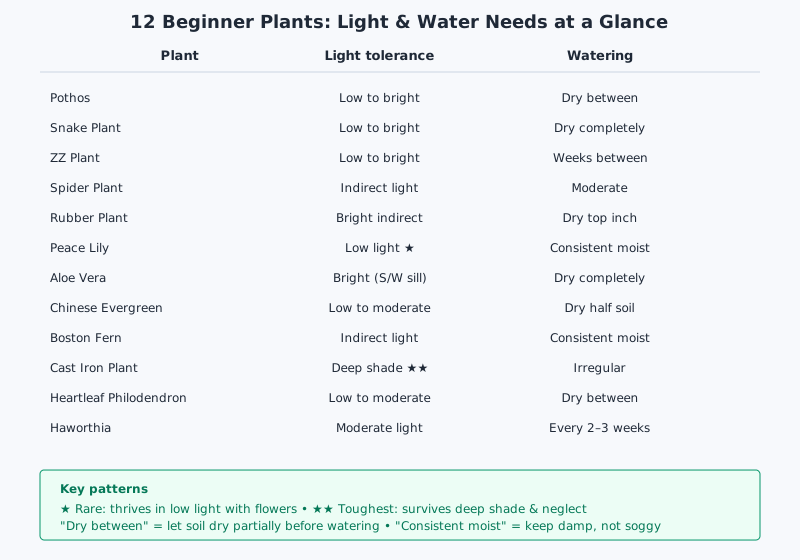
For anyone drawn to succulents but burned by them in low-light conditions, haworthias are the answer. Unlike most succulents, they’re native to shaded spots under shrubs and rocks in southern Africa, so they handle moderate indoor light without stretching and losing their shape. Water every two to three weeks, use well-draining soil, and skip the fertilizer most of the year. They stay small, rarely need repotting, and have an architectural quality that looks good on a desk or windowsill.

Practical Care Principles That Apply to All of Them
If you’re often away from home, How to Keep Houseplants Alive While Traveling: Wick Jars And Timers offers some clever low-effort setups to keep your new plants hydrated while you’re gone.
Water Less Than You Think
Overwatering kills more houseplants than underwatering. The standard advice — water once a week — is nearly useless because it ignores pot size, soil type, humidity, season, and light levels. A better rule: check the soil. Most of the plants above want to partially or fully dry out between waterings. Stick a finger two inches into the soil. If it’s still moist, come back in a few days.
Watering habits often need to shift with the seasons, so once you’ve got the basics down, check out How to Care for Houseplants in Winter: Why January Kills Your Plants to avoid the most common cold-weather mistakes.
Match Light to the Plant’s Origin
A plant from a tropical forest floor (pothos, ZZ, philodendron) evolved under a closed canopy with filtered light. It will burn in direct afternoon sun and cope fine three feet from a window. A plant from an open rocky hillside (aloe, haworthia) needs a bright spot. Before buying, look up where the plant grows in the wild — that mental model is more useful than any care card.
Pot and Soil Matter More Than Most Guides Admit
Drainage holes are non-negotiable for beginners. A beautiful pot without drainage will kill almost anything through root rot. If you love a decorative cachepot, use it as a sleeve and keep the plant in a plain nursery pot with drainage inside it. For succulents and cacti, add perlite to standard potting mix (roughly 1 part perlite to 2 parts mix) to improve drainage. For tropical foliage plants, standard indoor potting mix works fine.
Pests: Catch Them Early
Check the undersides of leaves periodically. Spider mites leave fine webbing; mealybugs look like small cottony dots; fungus gnats emerge from overly wet soil. Early detection usually means a simple fix — a neem oil spray, a sticky trap, or letting the soil dry out more between waterings. Ignored infestations spread to other plants and become genuinely difficult to manage.
Conclusion
The plants on this list aren’t a consolation prize for people who ’can’t grow things.’ Several of them — pothos, rubber plants, snake plants — are genuinely beautiful and used extensively by professional interior designers. The real advantage they offer beginners is room for error while you learn how your home’s light, humidity, and temperature actually behave across the seasons. Start with one or two, pay attention to what they tell you, and let the collection grow from there.